
Search
Remove Ads
Advertisement
Search Results

Article
Lugalbanda and the Anzud Bird - A Sumerian Hero's Journey
Lugalbanda and the Anzud Bird is a Sumerian myth dated to the Ur III period (circa 2112 to circa 2004 BCE) featuring the hero-king of Uruk, Lugalbanda, father of Gilgamesh, in his younger years...

Article
Cylinder Seals in Ancient Mesopotamia - Their History and Significance
Among the most interesting and revealing artifacts discovered from ancient Mesopotamia are cylinder seals. These fairly small items may be seen today in museum exhibits around the world...

Article
Azulejos: The Visual Art of Portugal
Glazed blue ceramic tiles or azulejos are everywhere in Portugal. They decorate the winding streets of the capital, Lisbon. They cover the walls of train stations, restaurants, bars, public murals, and fountains...

Image
Detail of the War Scene of the Standard of Ur Showing a Galloping Chariot
This is a detail of the so-called "War Scene" of the Standard of Ur from the right half of the bottom register. Here, a four-wheeled chariot is drawn by four galloping equids. The...
Image
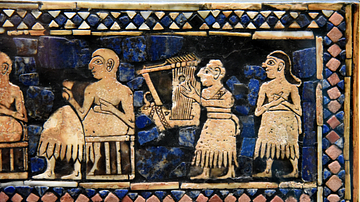
Lyrist and Singer from the Standard of Ur
This is a detail of the so-called "Peace Scene" of the Standard of Ur. Here, on the left, a man, wearing a flounced skirt, sits on a chair (or stool) and drinks from a cup. Behind him, a man holds (and plays...

Image
Detail of the War Scene of the Standard of Ur Showing Sumerian Warriors
This is a detail of the so-called "War Scene" of the Standard of Ur. This detail is part of the left half of the middle register. Here, six Sumerian soldiers stand and stride to the...

Image
The Mask of Warka
The mask of Warka, the first almost complete and life-size depiction of the human face in history, with respect to its anatomical details. It is made of marble and is about 20 cm tall. The eyes may have been inlaid with shells...
Image
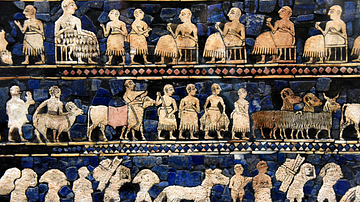
Peace Scene of the Standard of Ur
This is a close-up view of the so-called "Peace Scene" of the Standard of Ur. The scene is composed of three horizontal registers, showing a feast or a banquet. The central figure of the scene appears on the top...
Image
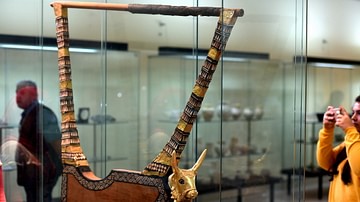
The Golden Lyre of Ur at the Iraq Museum
This is the finest among all lyres found at the Royal Cemetry at Ur and was given to the Iraq Museum; the other lyres were divided between the British Museum in the UK and the Penn Museum in the USA. The head...

Image
12 Renaissance Pigments That Shaped Masterpieces - Color, Trade & Materials in Renaissance Painting
During the Renaissance (c. 1400–1600), painters worked with pigments derived from minerals, metals, earths, plants, and insects. Their palettes reflected both artistic...
