
Search
Remove Ads
Advertisement
Search Results
Image
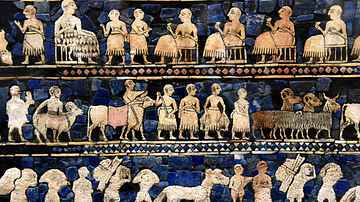
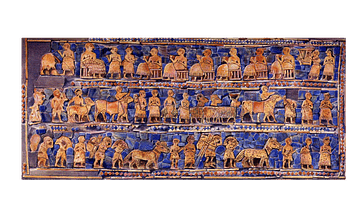
Peace Scene of the Standard of Ur
This is a close-up view of the so-called "Peace Scene" of the Standard of Ur. The scene is composed of three horizontal registers, showing a feast or a banquet. The central figure of the scene appears on the top...
Image
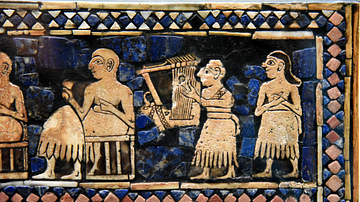
Lyrist and Singer from the Standard of Ur
This is a detail of the so-called "Peace Scene" of the Standard of Ur. Here, on the left, a man, wearing a flounced skirt, sits on a chair (or stool) and drinks from a cup. Behind him, a man holds (and plays...
Image
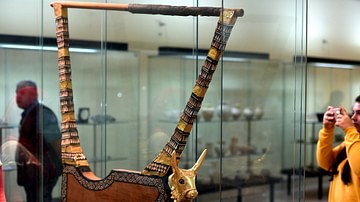
The Golden Lyre of Ur at the Iraq Museum
This is the finest among all lyres found at the Royal Cemetry at Ur and was given to the Iraq Museum; the other lyres were divided between the British Museum in the UK and the Penn Museum in the USA. The head...
Image
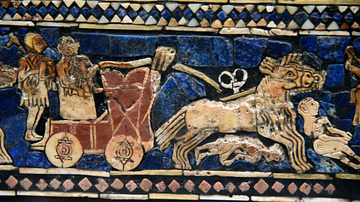
Detail of the War Scene of the Standard of Ur Showing a Galloping Chariot
This is a detail of the so-called "War Scene" of the Standard of Ur from the right half of the bottom register. Here, a four-wheeled chariot is drawn by four galloping equids. The...
Image
Reverse Side, Standard of Ur
The Standard of Ur is a (reconstructed) hollow box and its precise purpose is unknown. The scenes are made using a mosaic of lapis lazuli, red limestone, and shell. This reverse side shows men bringing animals as tribute...

Image
Detail of the War Scene of the Standard of Ur Showing Prisoners of War
This is a detail of the so-called "War Scene" of the Standard of Ur. This detail is the right end of the top register. Sumerian soldiers wearing flounced skirts lead prisoners of wars...
Image
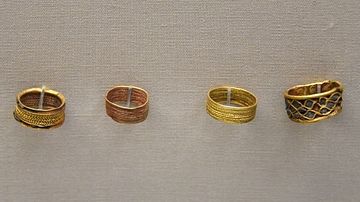
Mesopotamian Finger Rings
These rings were found on the fingers of a woman named Puabi, inside her grave. Puabi was a Semitic Akkadian woman from Ur, c. 2600 BCE, possibly a queen or priestess. Two rings were made of gold wire that was twisted...
Image
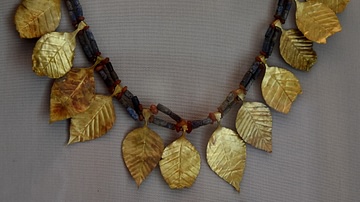
Headdress of One of Queen Puabi's Attendants
This woman's headdress is composed of a double row of carnelian and lapis lazuli beads. Thirteen gold leaf-shaped pendants are attached to the beads. The leaves appear to be polar leaves or leaves of the...
Image
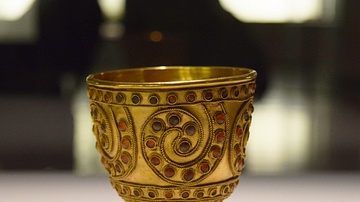
Ancient Goblet from Georgia
This goblet is made on a lath from a single piece of gold. It was found in Trialeti barrow no. 17, in eastern Georgia, and dates from the 18th-17th centuries BCE. It was made by craftsmen belonging to the Trialeti Culture...
Image
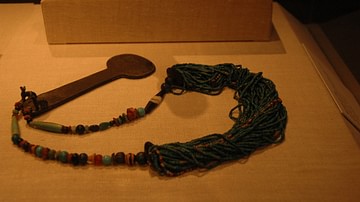
Menit Necklace
18th Dynasty, reign of Amenhotep III (c. 1390-1352 BCE)
Bronze or copper alloy, faience, glass, agate, carnelian, lapis lazuli, turquoise
Metropolitan Museum of Art
