
Search
Did you mean: Agora?
Remove Ads
Advertisement

 This answer was generated by
 Search Results

Article
Ivory & the Colonization of Africa
European colonising powers sought to exploit Africa's resources from the 15th century onwards. Arab traders had been doing the same in North Africa and East Africa through the Middle Ages, but it was from the 17th...

Image
Ivory Trading Station, French Congo
A late-19th-century photograph of an ivory trading station (factory) in French Congo.
Private Collection.
Image
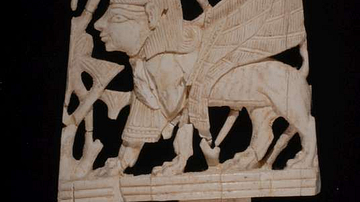
Ivory Furniture Inlay with Sphinx
This object is an ivory furniture inlay depicting a striding sphinx. It was excavated from Samaria and dates to the Iron Age II (9th–8th century BCE). It has a length of 7.5 cm and a width of 7 cm. (The Israel Museum...
Image
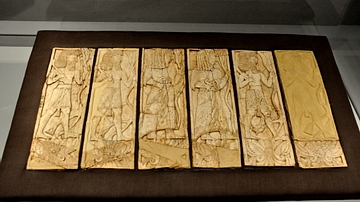
Ivory Plaque from Nimrud (Ancient Kalhu)
This ivory plaque depicts six Assyrian worshippers in procession in six vertical rectangles. Note the details of their dresses. The men are bare-chested and wear kilts while the women wear a full dress. Both...
Image
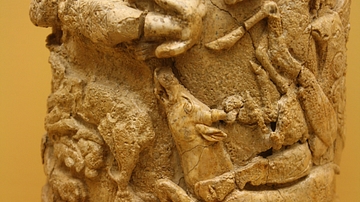
Ivory Pyxis
A Greek ivory pyxis depicting griffins attacking stags. 15th Century BCE. (Agora Museum, Athens)
Image
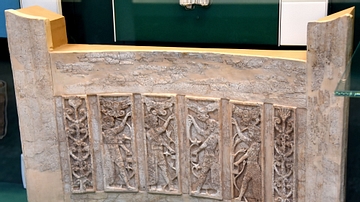
Ivory Back Rest From Nimrud
The 6 ivory panels, set within a plane framework, would originally have been mounted on the concave inner surface of a curved wooden support. By analogy with a similar curved back rest from Salamis in Cyprus, it seems...
Image
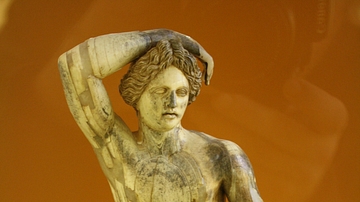
Ivory Statuette of Apollo
An ivory statuette of Apollo Lykeios, 3rd Century BCE. The statuette was restored after being found in 200 pieces at the bottom of a well. (Agora Museum, Athens)
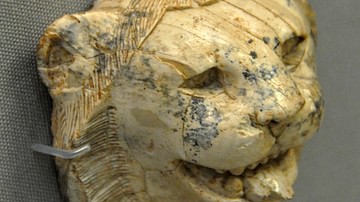
Image
Ivory Head of a Lion from Nimrud
Ivory head of a lion, part of the so-called "Nimrud Ivories" that decorated chariots, high-status furniture, and horse trappings. They were covered with thin gold leaf or ornamented with semiprecious stones. From...
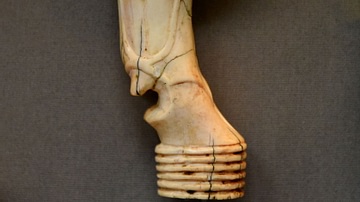
Image
Ivory Stool Leg
Stools were the most common pieces of furniture used in ancient Egypt. This ivory leg was probably attached to a frame by means of a leather thong lashed through the holes. From its cylinder shape, it was likely to have been the...
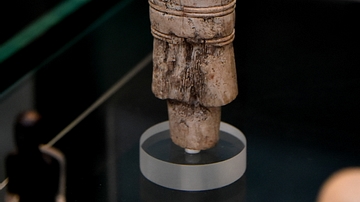
Image
Ivory Hand from The Fosse Temple
It is possible that this hand formed part of the temple's cult figure. LBII, 1400-1200 BCE. From the Fosse Temple at Lachish, modern-day Israel. (The British Museum, London).
