
Search
Did you mean: Agora?
Remove Ads
Advertisement
Search Results

Image
Ivory Token Depicting Egyptian Obelisk and Temple
This 1st Century CE ivory token depicts an Egyptian-style obelisk and temple, probably located in the Alexandrian suburb of Nikopolis. The token was probably produced in Roman Egypt and is now part of...
Image
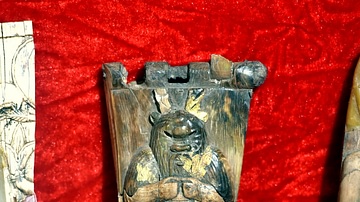
Ivory Horse Frontlet from Nimrud
This ivory piece is part of the so-called "equestrian bridle-harness ornaments". It represents the lower part of a hinged frontlet, virtually complete. Most of the hinges and much of the iron pin have survived...
Image
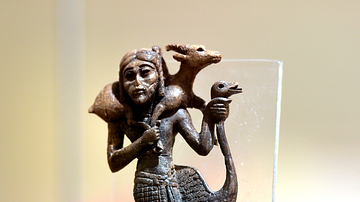
Ivory Figure of Syrian Man with an Ostrich & Goat, Nimrud
This burned ivory figure, carved in the round, depicts a male figure carrying a goat on his shoulders and holding an ostrich by the neck. The depiction is very realistic; the beak of the ostrich...
Image
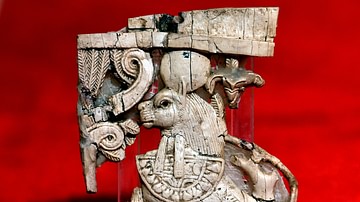
Ivory Panel Showing a Lion Facing a Tree
Fragmentary openwork, tenoned panel depicting a lion seated to the left and facing the stylized tree. The lion is crowned with the sun disc and displays pointed dog-like ears. It wears a lappet wig and usekh...

Article
The Nimrud Ivories - Their Discovery & History
The Nimrud Ivories are a vast collection of figures, panels, and plaques, carved from ivory, dated to the 9th to 7th centuries BCE, discovered in the ruins of the ancient city of Nimrud. Today, they are...

Image
Transporting Ivory, French Congo
A c. 1902 photograph showing Africans transporting ivory in French Congo.
Image
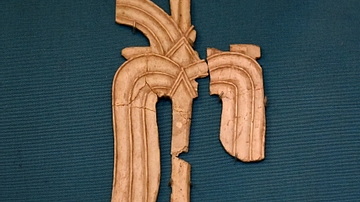
Carved Ivory from Samaria
This carved piece of ivory, in a Phoenician style, is part of large number of ivories which were found in the city of Samaria during the excavations of J. W. Crowfoot in 1931-1935 CE. They consist, for the most part, of...

Image
Byzantine Ivory Diptych Panel
This is one of the largest surviving ivories from the Byzantine Empire. It comes from a hinged 2-leaf diptych, possibly used as a writing table. It shows an archangel holding an orb and sceptre. The style of his drapery...
Image
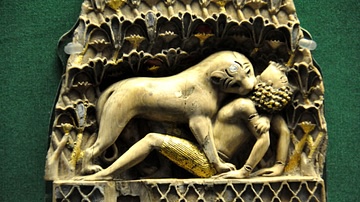
Lioness Devouring a Boy, Phoenician Ivory Panel
This Phoenician carved ivory panel is one of an almost identical pair with one now in the Iraq Museum, Baghdad. They originally formed part of a piece of furniture, perhaps a throne. The incised letter...

Image
19th-Century Ivory Traders, East Africa,
An 1880s photograph of ivory traders in East Africa.
