
Search
Did you mean: Agora?
Remove Ads
Advertisement
Search Results

Image
Phoenician Ivory Sphinx Plaque
This ivory plaque is part of the so-called "Nimrud Ivories." The sphinx wears the typical Egyptian Pharaohs' double crown and an apron with cobra. This indicates that the plaque was made by a Phoenician craftsman...

Image
Roman Ivory Doll
A Roman ivory doll from the mid-2nd century CE. From the 'Grottarossa Mummy' sarchophagus, Rome. (Palazzo Massimo, Rome)
Image
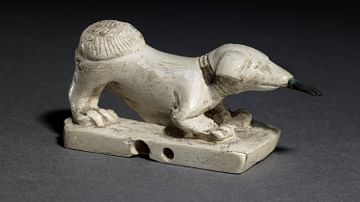
Egyptian Ivory Dog
A small ivory figurine of a dog swallowing a fish, with its tail rendered in bronze. From Thebes, New Kingdom of Egypt, 18th Dynasty (1350-1300 BCE).
The British Museum, London.
Image
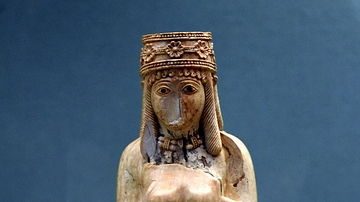
Urartian Ivory Figure of a Nude Woman
This ivory figure depicts a nude woman wearing an elaborate headgear and necklace. Excavated by E. Clayton and G. C. Raynolds. From Toprakkale, Eastern Anatolia, in modern-day Turkey. Urartian, 8th to 7th century...

Image
Sandal Ivory Label of Pharaoh Den
One of the Egyptian king's principal duties was to defend and expand the borders of Egypt. This ivory label, once tied to a pair of sandals, depicts king Den smiting a foreigner from the east. Rock carvings of Den...
Image
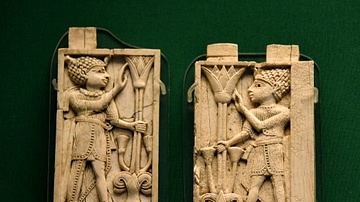
Nimrud Ivory Panels of Two Egyptian Kings
Two panels from a much larger composition, each showing a youth dressed in Egyptian royal costume grasping a tree formed by a lotus flower arising from a double volute. On the front of the lower right-hand...

Image
Painted Ivory Comb, Sri Lanka
A painted ivory comb, Sri Lanka, 18-19th century CE. On display as part of 'The Jeweled Isle: Art from Sri Lanka' exhibition, at the LACMA in Los Angeles, California (2018-19)
Image
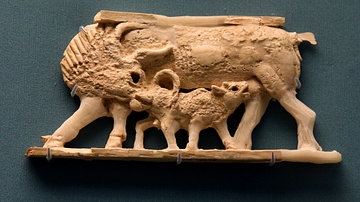
Nimrud Ivory Panel of a Suckling Calf
Never seen by the public before 2011. A small fragment of an ivory plaque from Nimrud. A standing cow turns her head towards a small calf. The calf appears to suckle milk from the cow's nipples. Neo-Assyrian Period...
Image
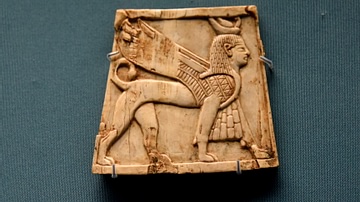
Nimrud Ivory Panel of a Winged Sphinx
Never seen by the public before 2011. A small fragment of an ivory plaque from Nimrud. This winged-sphinx is Egyptian and wears the double crown of Egypt as well as a chest apron, the typical royal costume of...
Image
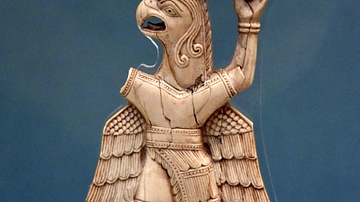
Urartian Ivory Demon
This is a griffin-headed demon of white ivory. Both arms are raised (the right is lost), probably to support a throne. From Toprakkale, Eastern Anatolia, in modern-day Turkey. Urartian, 8th to 7th century BCE. (The British...
