
Search
Did you mean: Agora?
Remove Ads
Advertisement
Search Results
Image
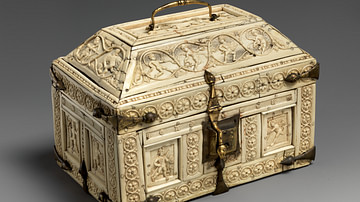
Byzantine Ivory Casket
Made in Constantinople in the 11th century CE, this casket is made of ivory and bone, and has gilded copper mounts. Depicted are dancers waging mock battles and taming a panther. (Metropolitan Museum of Art, New York)
Image
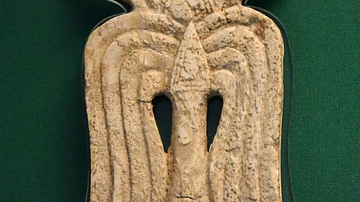
Nimrud Ivory Plaque of a Stylized Palm Tree
This ivory plaque shows a carving of a stylized palm tree. There are tenons at the top and bottom of the plaque. The overall depiction is very similar to a fragment found in Samaria (also housed in the Museum...
Image
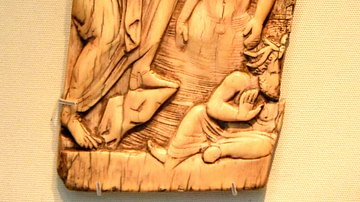
Byzantine Ivory Panel Depicting the Baptisim
A figure of the young Christ stands full-face up to the waist in water. To the left, St. John, the Baptist, stands and leans forward upon a rock. One of his hands rests upon Christ's head. At the upper part...
Image
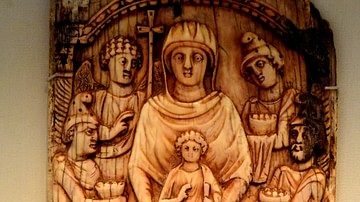
Byzantine Ivory Panel Depicting the Adoration of the Magi
The Virgin, in the center, sits and holds the child Christ in her lap. To the left behind her right shoulder, an angel carries a cross-staff. The 3 Magi (dressed in trousers, chlamyses and Phrygian...
Image
Carved Ivory from Sam'al
Ivory during the early ion age at Sam'al was used to decorate precious furniture and cosmetics boxes and most of them, when found, were burnt and charcolized by fire. Egyptianized scenes were the predominant ones. 9th to...

Image
Bell Piano with Ivory Keys
A photograph showing a detail of a Canadian Bell piano with ivory and ebony keys.
Image
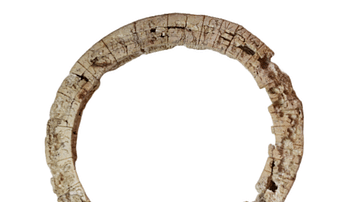
Minoan Ivory Sceptre Covered with Two Linear A Inscriptions
The Minoan ivory scepter discovered in Crete in 2024 is engraved with the longest Linear A inscription ever found. The inscription consists of approximately 119 signs covering the entire surface...
Image
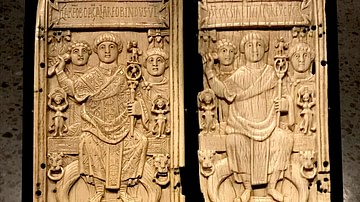
Byzantine Diptych of Ivory
Diptych (two-part writing tablet), ivory. c. 506 CE. From the collection of the Zurich historian J. H. Hottinger (1620-1667 CE). The man on the throne was called Areobindus. He is shown giving the signal to begin the animal...
Image
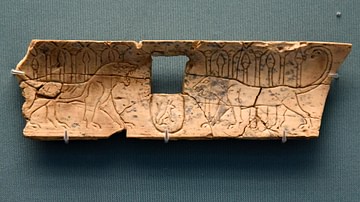
Nimrud Ivory Panel of Two Lionesses
Never seen by the public before 2011. A small fragment of an ivory plaque from Nimrud. On the ivory plaque, there are 2 carved roaring lionesses facing each other. Neo-Assyrian Period, 9th to 8th centuries BCE...

Image
Benin Ivory Hip Pendant Mask
A carved ivory hip pendant in the form of a mask. The kingdom of Benin (13-19th century CE) in West Africa (modern southern Nigeria). With bronze and iron inlays. Possibly depicting Queen Idia. Benin City, 16th century...
