
Search
Did you mean: Agora?
Remove Ads
Advertisement
Search Results
Image
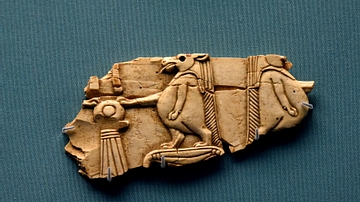
Nimrud Ivory Panel of Tawaret
Never seen by the public before 2011. A small fragment of an ivory plaque from Nimrud. Two figures of the Egyptian goddess Tawaret (the demon-wife of Apep and the first god of evil) can be seen. Phoenician art. Neo-Assyrian...
Image
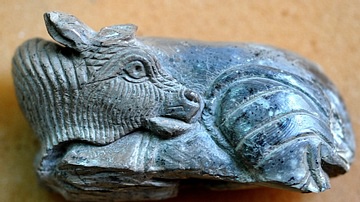
Nimrud Ivory Supine Bull
An exquisitely carved plaque of a supine bull. Note the black burn mark. Probably, this was part of a group which once supported an ivory tray. Neo-Assyrian period, 9th-7th centuries BCE. From Nimrud, Mesopotamia, Iraq...
Image
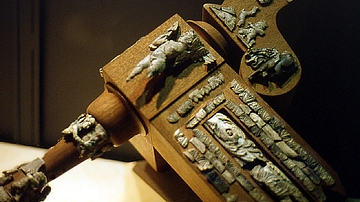
Cremated Ivory Cupids from a Funeral Couch, Rome
After cremation, the incinerated bones were picked out and sorted from the charred wood of the fire and the couch on which the body had been laid. While the bones would be collected and placed into an...
Image
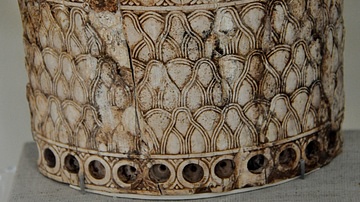
Fragment of an Ivory Cylinder from Fort Shalmaneser
This is a fragment of an ivory cylinder. The original decorative insets are lost. Neo-Assyrian Period, 8th century BCE. From Fort Shalmaneser at Nimrud, Mesopotamia, modern-day Iraq. A loan from the...
Image
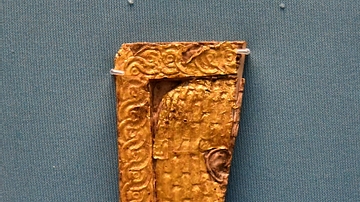
Nimrud Ivory Piece with Gold Overlay
Never seen by the public before 2011. A small fragment of an ivory plaque from Nimrud. It shows what appears to the right side of the head and neck, as well as right ear of a a figure. The golden overlay is still...
Image
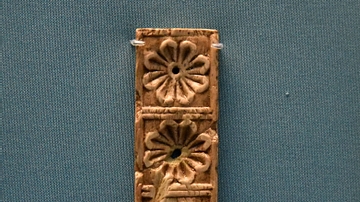
Small Nimrud Ivory Panel of Three Rosettes
Never seen by the Public before 2011. A small fragment of an ivory plaque from Nimrud. It was a carved panel with 3 perpendicular rosettes. The golden overlay is still intact. Neo-Assyrian Period, 9th to 8th...

Image
Nimrud Ivory Plaque of an Egyptian Sphinx
A winged human-headed sphinx wears the double crown of Egypt. An apron hangs down on the chest with a projecting uraeus (rearing cobra) similar to those worn by Egyptian pharaohs. A striking Phoenician style...
Image
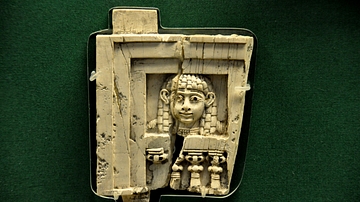
Woman at the Window Ivory from Nimrud
A woman looking out of a balustraded window was a popular theme in Phoenician art. This is possibly related to the goddess Astarte and ritual prostitution. This piece belongs to a large collection of the so-called...

Image
Cow & Calf Ivory Motif from Nimrud
This is one of the finest examples of the so-called "cow-and-calf" motif and is the only known to date to have been carved in the distinctive style of the "Ornate Group". On the right, a cow stands and turns her...
Image
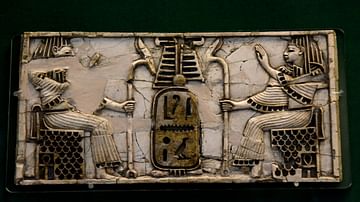
Nimrud Ivory Plaque of Two Seated Figures
Two figures sit facing each-other either side of a cartouche surmounted by two feathers. The inscription consisting of Egyptian hieroglyphs, cannot be read, the signs have been treated in a purely decorative...
