
Search
Did you mean: Agora?
Remove Ads
Advertisement
Search Results

Image
Nimrud Ivory Panel of a Winged Man
Never seen by the public before 2011. A small fragment of an ivory plaque from Nimrud. It shows a standing winged Egyptian man holding a stem of a lotus flower branching from a tree. The upper part shows a large...
Image
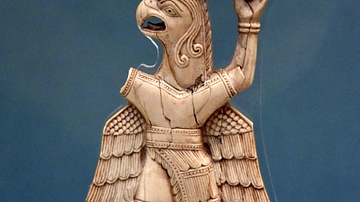
Urartian Ivory Demon
This is a griffin-headed demon of white ivory. Both arms are raised (the right is lost), probably to support a throne. From Toprakkale, Eastern Anatolia, in modern-day Turkey. Urartian, 8th to 7th century BCE. (The British...

Image
Nimrud Ivory of a Winged Sphinx
Never seen by the public before 2011. A small fragment of an ivory plaque from Nimrud. A winged human-headed sphinx wears the double crown of Egypt. An apron hangs down on the chest with a projecting uraeus (rearing...
Image
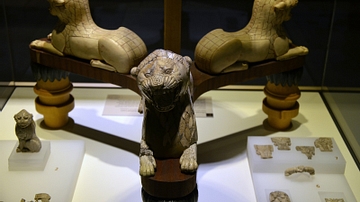
Urartian Tripod with Ivory Lions
Reconstruction of an Urartian tripod stand used for burning incense and for illumination. It is decorated with lions made of ivory, 8th century BCE. From Altintepe, an Urartian fortress and temple site located in...

Image
Nimrud Ivory Panel of a Winged Animal
Never seen by the public before 2011. A small fragment of an ivory plaque from Nimrud. The panel shows a winged 4-legged animal (mythical creature). Phoenician art. Neo-Assyrian Period, 9th to 8th centuries BCE...
Image
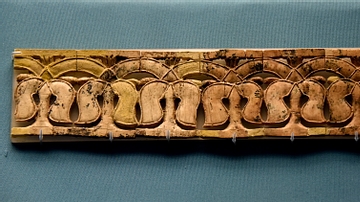
Nimrud Ivory Panel of Stylized Palms
Never seen by the public before 2011. A small fragment of an ivory plaque from Nimrud. There are repeated motifs of small stylized palm trees, arranged horizontally. Neo-Assyrian Period, 9th to 8th centuries BCE...
Image
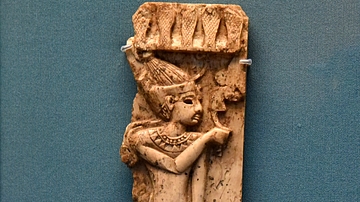
Nimrud Ivory Panel of an Egyptian king
Never seen by the public before 2011. A small fragment of an ivory plaque from Nimrud. The depicted/carved man wears the double crown of Egypt and a royal costume. Phoenician art. Neo-Assyrian Period, 9th to...
Image
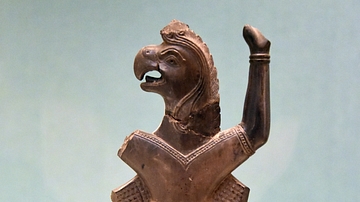
Urartian Blackened Ivory Panel
This is a griffin-headed demon of blackened ivory. Both arms are raised (the right is lost), probably to support a throne. From Toprakkale, Eastern Anatolia, in modern-day Turkey. Urartian, 8th to 7th century BCE...

Image
Nimrud Ivory Plaque
Carved ivory plaque of an Egyptian-looking woman. Note the black burn marks. Neo-Assyrian period, 9th-7th centuries BCE. From Nimrud, Mesopotamia, Iraq. (The Sulaimaniya Museum, Iraq).
Image
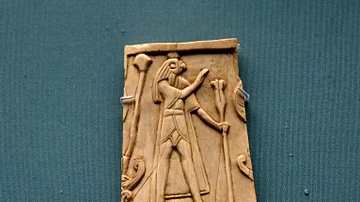
Nimrud Ivory Panel of a Falcon-headed God
Never seen by the public before 2011. A small fragment of an ivory plaque from Nimrud. There is figure of a falcon-headed Egyptian god. He is standing in a gesture of adoration in front of a tree. Phoenician...
