
Search
Remove Ads
Advertisement
Search Results

Definition
Bede
Bede (c. 673-735 CE) was an English monk, historian, and scholar who lived in the Kingdom of Northumbria. He is at times referred to as the Venerable Bede or Bede the Venerable. He was a monk at the double monastery of Monkwearmouth-Jarrow...

Definition
Mount Athos - The Byzantine Holy Mountain
Mount Athos, located on the Chalkidike peninsula near Thessalonica, Greece, is a holy site which first saw hermit monks living there in the 9th century CE. Regarded as one of the most important monastic sites...

Definition
Alfred the Great
Alfred the Great (r. 871-899) was the king of Wessex in Britain but came to be known as King of the Anglo-Saxons after his military victories over Viking adversaries and later successful negotiations with them. He is the best-known...

Definition
Anna Komnene
Anna Komnene (aka Anna Comnena, 1083-1153 CE) was the eldest daughter of Byzantine emperor Alexios I Komnenos (r. 1081-1118 CE) and the author of a lengthy biography of her father's reign, the Alexiad. Although not an impartial history...

Definition
Livonian Rhymed Chronicle - An Account of the Livonian Crusade
The Livonian Rhymed Chronicle (Livländische Reimchronik) is an anonymous account of the Livonian Crusade written in Middle High German, covering the years between 1143 and 1290. It is one of...

Definition
Easter
Easter is the Christian holiday that celebrates the resurrection of Jesus of Nazareth three days after he died from crucifixion by the Roman magistrate Pontius Pilate (c. 30 CE). Easter Sunday is the culmination of the week-long events...

Definition
Teutonic Knight
A medieval Teutonic Knight was a member of the Catholic military Deutscher Orden or Teutonic Order, officially founded in March 1198 CE. The first mission of the Teutonic knights was to help retake Jerusalem from the Arabs in...
Definition
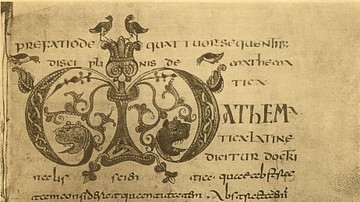
Etymologiae
The Etymologiae (Etymologies) is a Latin work by Isidore of Seville (l. c. 560 - 636 CE), compiled in the early 7th century CE and published in its final form shortly after his death. The book is a type of medieval encyclopedia and...

Definition
Marcus Aurelius
Marcus Aurelius (r. 161 to 180 CE) was a Roman emperor best known as the last of the Five Good Emperors of Rome (following Nerva, Trajan, Hadrian, and Antoninus Pius) and as the author of the philosophical work Meditations. Although...

Definition
Byzantine Art
Byzantine art (4th - 15th century CE) is generally characterised by a move away from the naturalism of the Classical tradition towards the more abstract and universal, there is a definite preference for two-dimensional representations...
