
Search
Remove Ads
Advertisement
Search Results

Definition
Visigoth
The Visigoths were the western tribe of the Goths (a Germanic people) who settled west of the Black Sea sometime in the 3rd century CE. According to the scholar Herwig Wolfram, the Roman writer Cassiodorus (c. 485-585 CE) coined the...

Definition
Seventh Crusade
The Seventh Crusade (1248-1254 CE) was led by the French king Louis IX (r. 1226-1270 CE) who intended to conquer Egypt and take over Jerusalem, both then controlled by the Muslim Ayyubid Dynasty. Despite the initial success of...

Definition
Robert Dudley, 1st Earl of Leicester
Robert Dudley, 1st Earl of Leicester (l. c. 1532-1588), was a high-ranking courtier who rose to become a favourite of Elizabeth I of England (r. 1558-1603). Rumours abounded that Dudley sought to marry the queen...

Definition
Johannes Brahms
Johannes Brahms (1833-1897) was a German composer of Romantic music best known for his symphonies, songs, and orchestral, chamber, and piano music. A great student of the history of music, Brahms was convinced that only by working...
Definition
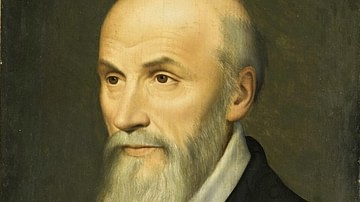
Michel de L'Hospital
Michel de L'Hospital (also known as L'Hôpital, c. 1505-1573) was a French statesman who served during the reigns of four kings – Francis I, Henry II, Francis II, and Charles IX – as Councillor of Parlement (1537), Chancellor...

Definition
Easter
Easter is the Christian holiday that celebrates the resurrection of Jesus of Nazareth three days after he died from crucifixion by the Roman magistrate Pontius Pilate (c. 30 CE). Easter Sunday is the culmination of the week-long events...

Definition
Teutonic Knight
A medieval Teutonic Knight was a member of the Catholic military Deutscher Orden or Teutonic Order, officially founded in March 1198 CE. The first mission of the Teutonic knights was to help retake Jerusalem from the Arabs in...
Definition
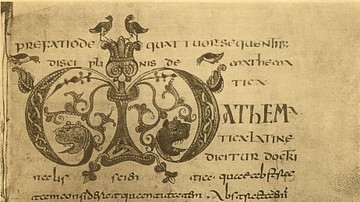
Etymologiae
The Etymologiae (Etymologies) is a Latin work by Isidore of Seville (l. c. 560 - 636 CE), compiled in the early 7th century CE and published in its final form shortly after his death. The book is a type of medieval encyclopedia and...

Definition
Marcus Aurelius
Marcus Aurelius (r. 161 to 180 CE) was a Roman emperor best known as the last of the Five Good Emperors of Rome (following Nerva, Trajan, Hadrian, and Antoninus Pius) and as the author of the philosophical work Meditations. Although...

Definition
Byzantine Art
Byzantine art (4th - 15th century CE) is generally characterised by a move away from the naturalism of the Classical tradition towards the more abstract and universal, there is a definite preference for two-dimensional representations...
