
Search
Remove Ads
Advertisement
Search Results

Article
Confucianism in Ancient Korea
Principles of Confucianism were adopted by successive dynasties and kingdoms in ancient Korea, and the study of classic Confucian texts was an important part of education and entrance examinations for the state administration...

Video
What the Ancients Knew: Chinese Innovations
This video describes the many interesting innovations of ancient and medieval China.

Definition
Viking Ships
Viking ships were built by the Scandinavians during the Viking Age (c. 790 CE - c. 1100 CE) and were used both within Scandinavia and beyond for purposes ranging from being the most important means of transport to trade and warfare...

Definition
Paolo Uccello
Paolo Uccello (1397-1475 CE), real name Paolo di Dono, was an Italian painter who is considered one of the founding fathers of Florentine Renaissance art. Uccello was one of the earliest artists to attempt certain tricks of perspective...

Definition
Tintoretto
Tintoretto (c. 1518-1594 CE), real name Jacopo Robusti, was an Italian Renaissance artist who specialised in religious, mythological, and portrait paintings. A prolific artist over a long career, the Venetian's masterpieces are famous...

Definition
Donatello
Donatello (c. 1386-1466 CE), full name Donato di Niccolo di Betto Bardi, was an Italian Renaissance artist best known for his sculptures such as the striking bronze figure of David now in the Bargello museum of his native Florence...

Definition
Ragnar Lothbrok
Ragnar Lothbrok (Old Norse Ragnarr Loðbrók, also anglicised as Ragnar Lodbrok), whose epithet means 'Hairy-breeches' or 'Shaggy-breeches', was a legendary Viking king, with Old Norse sagas, poetry, and medieval Latin sources telling...

Definition
Melusine
Melusine (pronounced Mel-ew-seen, also given as Melusina) is a legendary figure from European folklore depicted as a mermaid, sometimes with two tails, as a serpent from the waist down, or as a dragon. She is associated with the ruling...
Definition
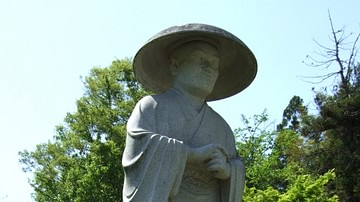
Ennin
Ennin (c. 793-864 CE, posthumous title: Jikaku Daishi) was a Japanese Buddhist monk of the Tendai sect who studied Buddhism at length in China and brought back knowledge of esoteric rituals, sutras, and relics. On his return, he published...

Definition
Qin Dynasty
The Qin Dynasty (221-206 BCE) was the first dynasty of Imperial China (defined as the era of centralized, dynastic government in China between 221 BCE and 1912 CE) which united the separate states following the Warring States Period...
