
Search
Remove Ads
Advertisement
Search Results

Definition
Goryeo
Goryeo (Koryo) ruled Korea from 918 to 1392. The kingdom oversaw an unprecedented flourishing in culture and arts with developments in architecture, ceramics, printing, and papermaking. The kingdom was repeatedly invaded by the Mongols...

Definition
Ancient Nara
Nara, located around 30 km south of modern Kyoto, was the capital of ancient Japan between 710 and 784 CE. It gave its name to the Nara Period (710-794 CE), although the name during the 8th century CE was Heijokyo. Modelled on the...

Definition
Cao Cao
Cao Cao (c. 155-220 CE) was a military dictator in ancient China during the end of the Han dynasty. Something more than a mere warlord, Cao Cao supported a puppet emperor and governed a large area of northern China. His attempts to unify...

Definition
Pax Mongolica - Trade and Cultural Exchange in the Mongol Empire
The Mongol Empire was the largest land empire in world history, at about 22,000,000 square kilometers (850,000 square miles). The term Pax Mongolica (Mongol Peace) refers to the way this massive...

Definition
Ancient Pyongyang
Pyongyang (aka Pyeongyang) was the capital of several successive ancient Korean kingdoms. Located on the Daedong River in the north of the peninsula, the site was chosen by the legendary Dangun (Tangun), founder of the first...
Definition
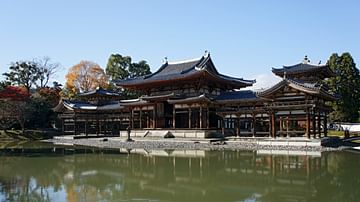
Heian Period
The Heian Period of Japanese history covers 794 to 1185 CE and saw a great flourishing in Japanese culture from literature to paintings. Government and its administration came to be dominated by the Fujiwara clan who eventually were...

Definition
Queen Himiko
Queen Himiko, also known as Pimiko or Pimiku (183? - 248 CE), was a 3rd-century CE ruler of the territory in ancient Japan known as Hsieh-ma-t'ai or Yamatai, later to be known as Yamato. Considered by the Chinese as the ruler of...

Definition
Marco Polo
Marco Polo (1254-1324 CE) was a Venetian merchant and explorer who travelled to China and served the Mongol ruler Kublai Khan (l. 1214-1294 CE) between c. 1275 and 1292 CE. Polo's adventures are recounted in his own writings, The...

Definition
Manila Galleon
The Manila galleons were Spanish treasure ships which transported precious goods like silk, spices, and porcelain from Manila in the Philippines to Acapulco, Mexico, between 1565 and 1815. The Atlantic treasure fleets then shipped...

Definition
Asuka Period
The Asuka Period (Asuka Jidai) of ancient Japan covers the period from 538 CE to 710 CE and, following on from the Kofun Period (c. 250-538 CE), so constitutes the latter part of the Yamato Period (c. 250-710 CE). For some scholars...
