
Search
Remove Ads
Advertisement
Search Results

Image
Chinese Standing Bodhisattva
This standing bodhisattva made of Sandstone comes from Cave 14 from the renown temples of Tianlongshan in China's Shanxi province. The influence from Greco-Roman art as well as South Asian art is palpable. It was made...
Image
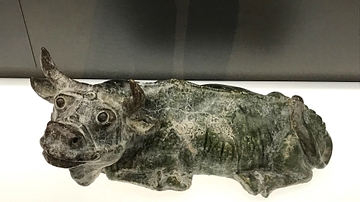
Ancient Chinese Water Buffalo Figure
This figurine of a reclining water buffalo comes from northern China. It was created during the period of the Eastern Han Dynasty, c. 2nd-3rd centuries CE. (Museum Rietberg, Zürich).

Image
Chinese Vessel in the Shape of a Duck and Rhyton
This beautiful vessel in the shape of a duck and rhyton comes from China's Henan province, and it was made at the Gongxian kilns during the Tang Dynasty. It is believed to have been created during the...

Image
Viking Dragon Plaque
Plaque from a late 9th- or early 10th-century burial at Scar, Sanday in the Orkney Islands, Scotland. Orkney Museum. The plaque, carved from one piece of whalebone into the shape of two dragons facing each other, was found...

Image
Vahagn the Dragon Slayer
A modern statue of Vahagn, the figure from Armenian mythology who was famed for his slaying of dragons and association with the Sun. Sculpted by Karlen Nurijanyan. Near Yerevan, Armenia.

Image
Epic of Dietrich von Bern, Sintram, and the Dragon
Sculpture from the Church of Saint Peter and Saint Paul in Rosheim, France, 12th century.

Definition
Emperor Taizong of Tang
Taizong (birth name, Li-Shimin, l. 598-649 CE, r. 626-649 CE) was the second emperor of the Tang Dynasty and is considered one of the greatest rulers in Chinese history for his reforms of the government and the laws, his...

Definition
Three Kingdoms Period in Korea
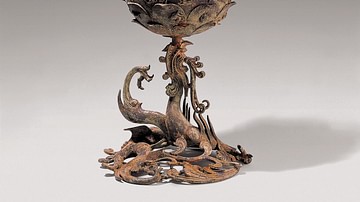
The Three Kingdoms Period of ancient Korea (57 BCE – 668 CE) is so-called because it was dominated by the three kingdoms of Baekje (Paekche), Goguryeo (Koguryo), and Silla. There was also, though, a fourth entity...
Definition
Baekje
Baekje (Paekche) was one of the Three Kingdoms which ruled over ancient Korea from the 1st century BCE to the 7th century CE. Controlling territory in the south-western part of the peninsula the kingdom was in constant rivalry with the...

Definition
Ming Porcelain
The porcelain of the Ming Dynasty of China (1368-1644 CE) benefitted, as did other arts, from the economic success of the 15th century CE, in particular, and the consequent surge in demand for quality handcraft production both...
