
Search
Did you mean: Bes?
Remove Ads
Advertisement
Search Results
Article
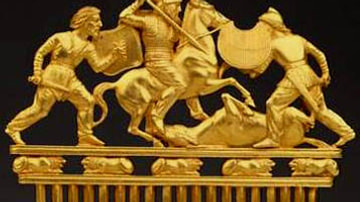
Parthian-Scythian Relations
While little is written about Parthian-Scythian relations, not only did the Parthians share origins with the Scythians and cooperated militarily but social, cultural, and commercial interactions were likely as well. Essentially leading a...

Article
Celtic Brooches - The Jewellery of the Ancient Celts
Ancient and medieval Celtic cultures produced many forms of jewellery, and one distinctive category is their brooches, fibulae, and pins. Without zips and buttons, brooches were used to close items of clothing, to create a pleasing or fashionable...

Article
Chester: A Time-Travelling City
It is said that Chester is the richest city in Britain in terms of archaeological and architectural treasures. One of the finest strategic outposts of the Roman Empire, it is one of the few walled cities left in Britain today. Rachael Lindsay...
Article
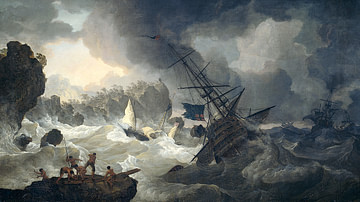
Top 5 'Deep-Dive' Virtual Shipwrecks
According to UNESCO, an estimated three million shipwrecks are scattered in the oceans’ deep canyons, trenches, and coral reefs and remain undiscovered. These shipwrecks preserve historical information and provide clues about how people lived...

Image Gallery
A Gallery of Ancient African Art
In this gallery, we look at striking examples of art from across the African continent. In gold, stone and metals, ancient and medieval African artists have not only given us unique pieces of art to admire but their works are also an insight...

Collection
Travel & Exploration Before Columbus
Ancient peoples were as curious as ourselves about the wider world and even if the transport at their disposal meant travel could be long, arduous and dangerous, they still managed to get about and visit different cities, sacred sites and...
Image
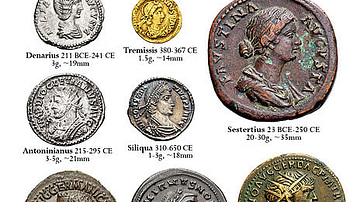
Roman Coins
Some of the most common Roman coins, including the gold aureus, silver denarius and brass sestertius.

Image
Persian Astrolabe
A brass planispheric astrolabe engraved with Arabic script. Probably Persian and dating to c. 1650. The astrolabe was a device used to measure the position of stars, time, and as a surveying tool. (Science Museum, London)
Image
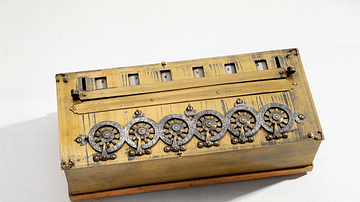
Pascal's Calculator
A replica of the calculating machine made in 1642 by the French mathematician, scientist, and philosopher Blaise Pascal (1623-1662). Made of brass and 28 cm in length. (Science Museum, London)

Image
European Astrolabe
A European brass planispheric astrolabe, made in Italy c. 1500. The astrolabe was a device used to measure the position of stars, time, and as a surveying tool. (Science Museum, London)
