
Search
Did you mean: Bes?
Remove Ads
Advertisement
Search Results

Article
Hygieia, the Goddess of Health
Modern medicine has its origin in the ancient world. The oldest civilizations used magic and herbs to cure their sick people, but they also used religion to free them from harm and to protect their health. The medical care of today has its...

Article
Daily Life in the Byzantine Empire
Daily life in the Byzantine Empire, like almost everywhere else before or since, largely depended on one's birth and the social circumstances of one's parents. There were some opportunities for advancement based on education, the accumulation...

Article
Travel in the Ancient Greek World
Travel opportunities within the ancient Greek world largely depended on status and profession; nevertheless, a significant proportion of the population could, and did, travel across the Mediterranean to sell their wares, skills, go on religious...

Article
Vikings in Wales
The Norse may have ruled parts of northern Wales in the early 11th century, specifically in Anglesey and Gwynedd, though the degree to which is unclear. Old Norse had relatively little impact on Welsh linguistics, and the Old Norse influenced...
Article
Grave Goods in Ancient Egypt
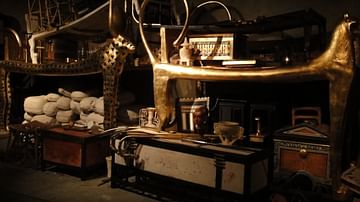
The concept of the afterlife changed in different eras of Egypt's very long history, but for the most part, it was imagined as a paradise where one lived eternally. To the Egyptians, their country was the most perfect place which had been...
Article
Dogs & Their Collars in Ancient Greece
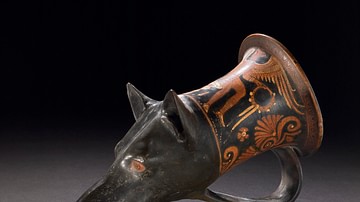
Dogs in ancient Greece are regularly depicted in art, on ceramics, in literature, and other written works as loyal companions, guardians, hunters, and even as great intuitive thinkers; all of these expressing the deep admiration the Greeks...

Article
Battles of Lexington and Concord
The Battles of Lexington and Concord were engagements fought between British regular soldiers and militia from the colony of Massachusetts on 19 April 1775. The British troops were on their way to seize military supplies stored in the town...

Article
Cavalry in the English Civil Wars
Cavalry regiments were an essential component of both Royalist and Parliamentarian field armies during the English Civil Wars (1642-1651). Armed with a sword, carbine, and a brace of pistols, cavalry riders evolved to become fast, lightly-armoured...

Article
Colonial American Currency
Colonial American currency was a work in progress from the time of the earliest English settlements of the 1600s until the United States of America minted its own money in 1783. The monetary system was far from standardized, and trade within...
Article
Parthian-Scythian Relations
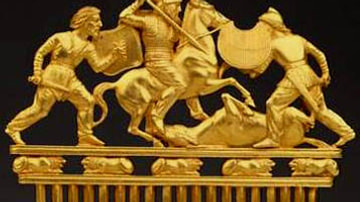
While little is written about Parthian-Scythian relations, not only did the Parthians share origins with the Scythians and cooperated militarily but social, cultural, and commercial interactions were likely as well. Essentially leading a...
