
Search
Did you mean: Anu?
Remove Ads
Advertisement
Search Results
Image
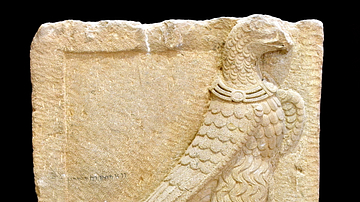
Relief of an Eagle from Hatra
The eagle was the symbol of the Hatrene army and reflects victory. There are Aramaic inscriptions below the eagle and behind his wings about certain laws in the city of Hatra. From Hatra, Ninawa Governorate, Iraq. Parthian...

Image
Komast Dancers on an Attic Black-figure Cup
Attic black-figure cup from c. 580-560 BCE, attributed to the Painter of Copenhagen 103, in J. Paul Getty Museum 79.AE.128. Komos-dancing was a common behaviour after a symposium. The now properly drunk...

Image
Portrait of an Extraordinary Musical Dog
An 1805 oil-on-canvas painting by the English artist Philip Reinagle (1749-1833) known as Portrait of an Extraordinary Musical Dog. The purpose of the portrait is debated since it could be the artist's sense...
Image
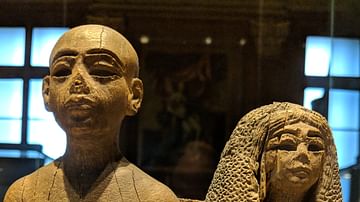
Sementaoy and Rouiay, an Egyptian Couple
Wooden figurine depicting an Egyptian couple (c. 1350-1300 BCE): Sementaoy, servant of the king, and his wife Rouiay, singer of Amon. Underneath the seat of the wife, a pet monkey is eating fruit (not visible...

Image
Mixed Flowers in an Earthenware Pot by Renoir
An 1869 oil on canvas still-life, A Vase of Flowers, by Pierre-Auguste Renoir (1841-1919) the French impressionist painter. Renoir was keenly interested in painting flowers throughout his career and found...
Image
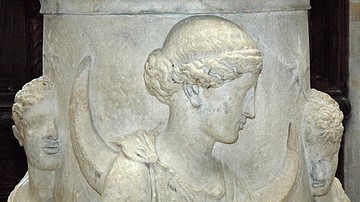
Selene on an Altarpiece
The moon goddess Selene or Luna accompanied by the Dioscuri, or Phosphoros (the Morning Star) and Hesperos (the Evening Star). Marble altar, Roman artwork from Italy, 2nd century CE.
Image
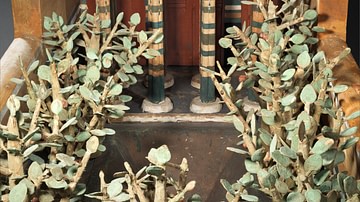
Model of an Egyptian House with Garden
Model of an ancient Egyptian house with a front garden. From the tomb of Meketre in Thebes, Egypt c. 1981-1975 BCE.
Metropolitan Museum of Art, New York.

Image
Folio from The Blue Qur'an
Most likely from North Africa dating from the late 9th to mid 10th-century, the celebrated Blue Qur'an was a luxurious book with pages dyed in indigo, and Kufic calligraphy in gold foil, and silver bookmarks. Consisting...

Image
Boundary Marker with an Official Inscription from Chalkidiki
Inscribed stone boundary marker from Chalkidiki, c.350 to 300 BCE. Archaeological Museum of Thessalonika. It is an example of ancient Greek boundary markers, known as horoi, and it contains...

Image
Alabaster Relief of an Assyrian Royal Attendant
Alabaster work relief of an Assyrian royal attendant, from the northwest palace of Ashurnasirpal II. Reign of Ashurnasirpal II, 883-859 BCE, Nimrud (ancient Kalhu), Mesopotamia. (The Burrell Collection...
