
Search
Did you mean: Anu?
Remove Ads
Advertisement
Search Results

Image
Face from an Egyptian Coffin
A face of a woman fragment from an Egyptian coffin. New Kingdom of Egypt, 18th-20th Dynasty, 1550-1070 BCE.
Egyptian Museum, Turin.

Image
Remnants of an Army by Thompson
An 1879 painting titled 'Remnants of an Army' by Elizabeth Thomson showing Dr William Brydon, the sole European survivor of the Retreat from Kabul in 1842 during the First Anglo-Afghan War (1838-42). (Tate Britain)
Image
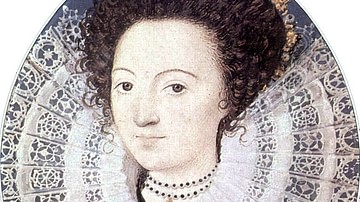
Portrait of an Unknown Woman, Possibly Emilia Lanier
A portrait of an unknown woman, thought to be Emilia Lanier Bassano, English poet and perhaps the inspiration behind William Shakespeare's 'Dark Lady'. Watercolor on vellum, by Nicholas Hilliard, circa...

Image
Greek Fighting an Amazon (Detail)
Greek warrior fighting an Amazon, detail from a painted alabaster sarcophagus, photograph by Sailko, Italy, 01 January, 2014. Section of the painted alabaster sarcophagus known as the "Amazon Sarcophagus" found...
Image
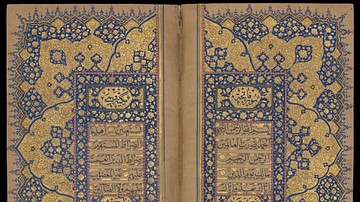
Qur'an Manuscript
Qur'an Manuscript, ink, gold, and lapis on paper, with leather binding, India, Kashmir, late 18th–early 19th century.
Metropolitan Museum of Art, New York.
Image
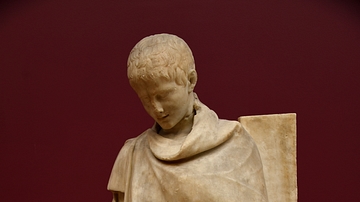
Statue of an Ephebe from Tralles
This is an ephebe, a young athlete, probably around the age of 12 years. He is leaning on a long rectangular pillar; the latter would have been originally topped by a herm or some kind of a relief. He must have just...

Image
Boundary Marker with an Official Inscription from Chalkidiki
Inscribed stone boundary marker from Chalkidiki, c.350 to 300 BCE. Archaeological Museum of Thessalonika. It is an example of ancient Greek boundary markers, known as horoi, and it contains...
Image
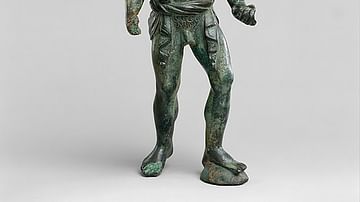
Hellenistic Bronze Statuette of an Aethiopian Youth
This Hellenistic bronze statuette of an African youth dates to sometime between the 2nd-3rd Centuries BCE. It portrays a young worker, likely a blacksmith or other artisan, of Sub-Saharan African origin...
Image
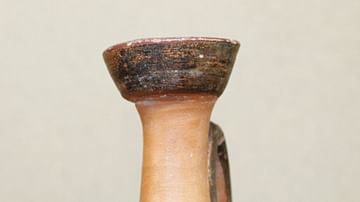
Dolon on an Attic Red-figure Lekythos
Dolon, the son of Emuedes was a participant in the Trojan War and fought for Troy. On this Attic red-figure lekythos dated to 460 BCE, Dolon is depicted walking on all fours and covered in a wolf skin as a disguise...
Image
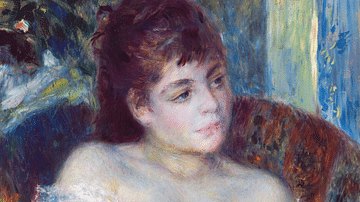
Woman in an Armchair by Renoir
An 1874 oil on canvas, Woman in an Armchair, by Pierre-Auguste Renoir (1841-1919) the French impressionist painter. Renoir was expert at relaxing his sitter and extracting from them a natural pose. He frequently used...
