
Search
Did you mean: Anu?
Remove Ads
Advertisement
Search Results
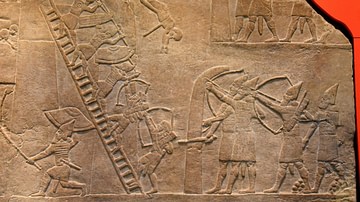
Image
Assyrian Archers Attacking an Egyptian Fortress at Memphis
Detail of a large gypsum wall panel showing the Assyrian army attacking the Egyptian city of Memphis and commemorating the final victory of the Assyrian king Ashurbanipal II over the Egyptian...
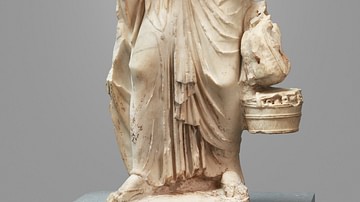
Image
Marble Statue of an Old Woman
Roman sculpture of an elderly woman, c. 14-68 CE, a copy of a 2nd-century BCE Hellenistic original.
Metropolitan Museum of Art, New York.
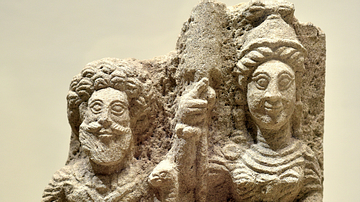
Image
Goddess Al-Lat and an Elderly God from Hatra
This limestone slab carved in relief shows two deities. On the right, the goddess Al-Lat is depicted, she wears a military dress and helmet and holds a spear in her right hand and a shield in her left arm...

Image
Diogenes in Search of an Honest Man
An 18th century CE painting showing Diogenes of Sinope looking for an honest man (Johann Heinrich Wilhelm Tischbein - Nagel Auktionen)
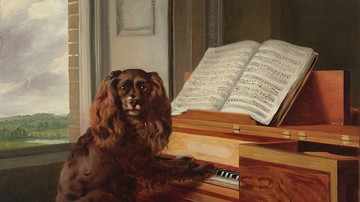
Image
Portrait of an Extraordinary Musical Dog
An 1805 oil-on-canvas painting by the English artist Philip Reinagle (1749-1833) known as Portrait of an Extraordinary Musical Dog. The purpose of the portrait is debated since it could be the artist's sense...

Image
Folio from The Blue Qur'an
Most likely from North Africa dating from the late 9th to mid 10th-century, the celebrated Blue Qur'an was a luxurious book with pages dyed in indigo, and Kufic calligraphy in gold foil, and silver bookmarks. Consisting...
Image
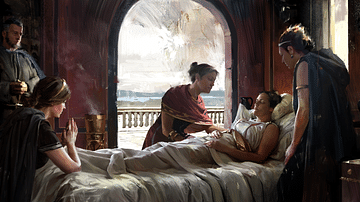
Artist's Depiction of an Ailing Woman
An artist's depiction of an ailing queen in the ancient Mediterranean, likely Greece or Macedon. From the game Old World.
Image
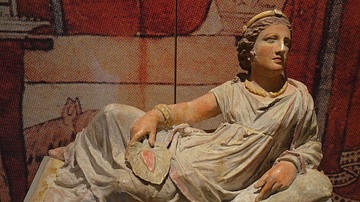
Funerary urn lid of an Etruscan woman
Painted terracotta funerary urn lid of an Etruscan woman, from Chiusi, ca. 150-120 BCE (Badisches Landesmuseum Karlsruhe, Germany).

Image
Remnants of an Army by Thompson
An 1879 painting titled 'Remnants of an Army' by Elizabeth Thomson showing Dr William Brydon, the sole European survivor of the Retreat from Kabul in 1842 during the First Anglo-Afghan War (1838-42). (Tate Britain)
Image
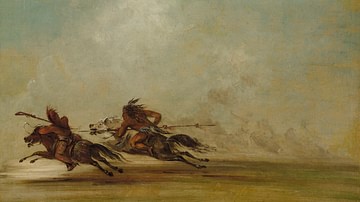
Comanche Warrior Lancing an Osage
Comanche Warrior Lancing an Osage, at Full Speed, oil on canvas by George Catlin, 1837-1839.
Smithsonian American Art Museum, Washington, DC.
