
Search
Did you mean: Anu?
Remove Ads
Advertisement
Search Results

Image
Diorite statue of an Akkadian ruler of Ashur
This statue was unearthed during the German excavations at the city of Ashur in 1905 CE. The statue depicts a man in a long gown, which is girded at the waist with a belt. The details of the body, especially...

Image
Chang'an Street Plan
An illustration of the town planning at the Chinese capital Chang'an. The city was the capital of the Western Han and Tang dynasties, amongst others. The orange section indicates the royal palace.
Image
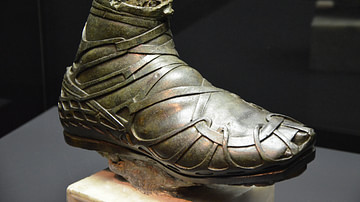
Bronze caliga from an over life-size statue of a Roman cavalryman
This bronze caliga was part of an over life-size statue of a Roman cavalryman from the 1st or the 2nd century CE. Caligae were heavy hob-nailed military boots worn by Roman legionary soldiers...

Image
Nimrud Ivory Plaque of an Egyptian Sphinx
A winged human-headed sphinx wears the double crown of Egypt. An apron hangs down on the chest with a projecting uraeus (rearing cobra) similar to those worn by Egyptian pharaohs. A striking Phoenician style...

Image
Roman Mosaic of an Aethiopian Fisherman
This mosaic from the Antakya Archaeological Museum, Hatay Province, Turkey dates to the 2nd Century CE and depicts a black African fisherman.
Image
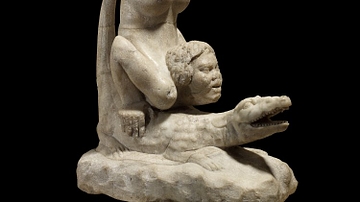
Roman Sculpture of an African Acrobat
This marble sculpture from Rome, Italy dates to sometime between the 1st Century BCE and the 1st Century CE. It portrays a young male Aethiopian, or black African, acrobat balancing on a crocodile. (British Museum...
Image
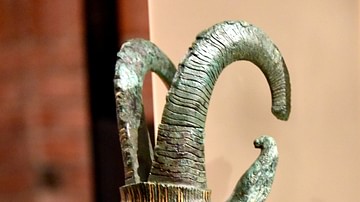
Head of an Ibex
This bronze and gilded head of an Ibex or a capricorn was part of sacred bark which might be carried on the shoulders of a procession of priests during rituals. Probably from Zagazig, Egypt. Third Intermediate Period, 21st Dynasty...

Image
Slaves on an Antiguan Sugar Plantation
A scene showing slaves working on an Antiguan sugar plantation. Created in 1779 by Thomas Hearne. On the left are slaves cutting the cane, in the centre is the windmill for processing the cane and on the right...
Image
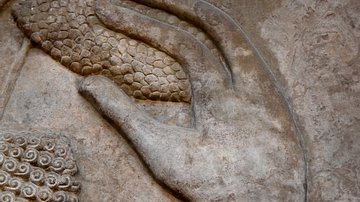
Pine Cone Held by an Apkallu, Panel 4
Alabaster bas-relief detail depicting an Apkallu holding a pine cone. Neo-Assyrian Period, 865-860 BCE. Detail of Panel 4, Room G, the North-West Palace at Nimrud, modern-day Iraq. (The British Museum, London)
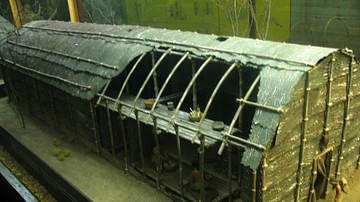
Image
Exterior and Cutaway View of an Iroquois Longhouse
Exterior and cutaway view of an Iroquois longhouse.
American Museum of Natural History, New York.
