
Search
Did you mean: Armenian Mythology?
Remove Ads
Advertisement
Search Results

Article
Twelve Gods of Persian Mythology
Ancient Persian Mythology is the term now referencing ancient Iranian religion prior to the rise of Zoroastrianism between c. 1500-1000 BCE. This was a polytheistic faith with a pantheon led by the supreme god Ahura...

Definition
Gutians - The Great Villains of the Sumerian Scribes
The Gutians were a West Asiatic people who are thought to have lived around the Zagros Mountains in a region referred to as Gutium. They had no written language and all that is known of them comes from...

Image
Map of the Sumerian Civilization - Where Cities Began
The rise of Sumerian civilization in southern Mesopotamia (c. 6000–2300 BCE) represents one of the earliest transformations from agrarian village life to urban state formation. Located between the...

Article
Magic Rings in Norse Mythology
Elements of Norse mythology abound in The Lord of the Rings, and none is so compelling as the ring itself. The One Ring is reminiscent of magic rings in Norse lore, especially Odin's Draupnir or Andvaranaut from the...
Article
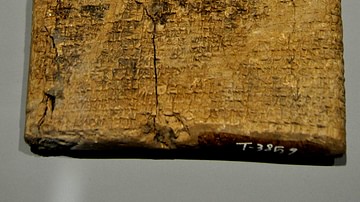
Matter of Aratta
The Matter of Aratta is the modern-day title for a collection of four poems – Enmerkar and the Lord of Aratta, Enmerkar and En-suhgir-ana, Lugalbanda in the Mountain Cave, and Lugalbanda and the Anzud Bird – concerning the rivalry...

Article
A Visual Who's Who of Greek Mythology
Achilles The hero of the Trojan War, leader of the Myrmidons, slayer of Hector and Greece's greatest warrior, who sadly came unstuck when Paris sent a flying arrow guided by Apollo, which caught him in his...

Article
Elves & Dwarves in Norse Mythology
Elves and dwarves represent minor divine figures in Norse mythology. Elves (álfar) and dwarves (dvergar) have in common their talent for creating precious objects, skill, agility, and moral ambiguity. Dwarves appear...
Definition
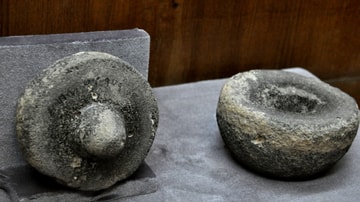
Mesopotamian Science and Technology - Scientific Method in the Ancient Near East
Mesopotamian science and technology developed during the Uruk period (circa 4000-3100 BCE) and the Early Dynastic period (circa 2900-2350/2334 BCE) of the Sumerian culture of...

Definition
Elam - The Ancient High Country
Elam was a region in the Near East corresponding to the modern-day provinces of Ilam and Khuzestan in southern Iran (though it also included part of modern-day southern Iraq) whose civilization spanned thousands of...
Image
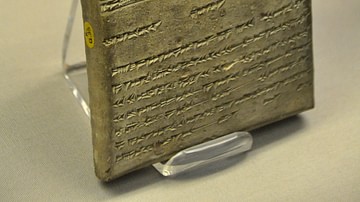
Sumerian Hymn to Ishtar
This hymn to the goddess Ishtar is written in Sumerian; after every line in Sumerian, the text is translated in Akkadian. Such translations have been invaluable to modern scholars. They reflect how the Sumerian language...
