
Search
Did you mean: Armenian Mythology?
Remove Ads
Advertisement
Search Results
Image
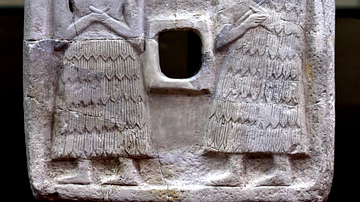
Limestone Sumerian Plaque from Khafajah
This limestone plaque depicts two figures in relief. Cuneiform inscriptions appear at the upper part. It was excavated by the Oriental Institute of the University of Chicago in the early 1930s, 3rd season. The...

Definition
Amorite
The Amorites were a Semitic people who seem to have emerged from western Mesopotamia (modern-day Syria) at some point prior to the 3rd millennium BCE. In Sumerian they were known as the Martu or the Tidnum (in the Ur III Period), in...

Article
Shulgi and Ninlil's Barge - A Poem Celebrating a Divine Event
Shulgi and Ninlil's Barge is a Sumerian poem dated to the reign of Shulgi of Ur (2094 - circa 2046 BCE) celebrating the caulking of the barge of the goddess Ninlil, consort of the sky god Enlil...

Article
Lullaby for a Son of Shulgi - A Single Moment Preserved in Time
Lullaby for a Son of Shulgi is a Sumerian cradlesong from the reign of Shulgi of Ur (2094 to circa 2046 BCE) written for one of his sons. The lullaby follows a standard form of encouraging...

Article
The Hymn to Ninkasi, Goddess of Beer - A Praise Song and Ancient Beer Recipe
The Hymn to Ninkasi is at once a song of praise to Ninkasi, the Sumerian goddess of beer, and an ancient recipe for brewing (though this claim has been challenged). Written down...

Definition
Assur - The Supreme God of the Ancient Assyrians
Assur (also Ashur, Anshar) is the god of the ancient Assyrians who was elevated from a local deity of the city of Ashur to the supreme god of the Assyrian pantheon. His attributes were drawn from earlier...

Definition
Ur-Nammu - Founder of the Sumerian Renaissance
Ur-Nammu (circa 2112-2094 BCE) was the founder of the Third Dynasty of Ur in Sumer, who initiated the so-called Ur III period (circa 2112 to circa 2004 BCE), also known as the Sumerian Renaissance. He is...

Definition
Ziggurat - Mountains of the Gods
A ziggurat is a form of monumental architecture originating in ancient Mesopotamia, which usually had a rectangular base and was built in a series of steps up to a flat platform upon which a temple was raised. The...

Definition
Uruk - The First Great City
Uruk was one of the most important cities (at one time, the most important) in ancient Mesopotamia. According to the Sumerian King List, it was founded by King Enmerkar circa 5000/4500 BCE. Uruk is best known as the birthplace...

Video
Early Dynastic Mesopotamia | Ancient Documentary | The Sumerian and Akkadian Empires.
The Early Dynastic Period of Mesopotamia is the modern-day archaeological term for the era in Mesopotamian history — 2900-2334 BCE — during which some of the most significant...
