
Search
Did you mean: Sulla?
Remove Ads
Advertisement
Search Results
Image
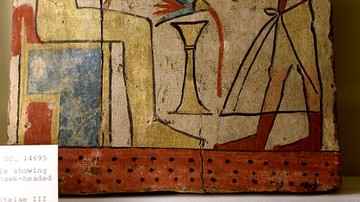
Stela of Ihefy & Horus
This painted wooden stela depicts a man (his name is identified as Ihefy and his title was "the doorkeeper of the house of Amun") adoring the hawk-headed god Horus. Horus sits on a throne and holds a flail. There is a red...
Image
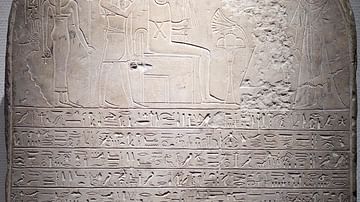
Stela of Herihor
Stela of Herihor, High Priest of Amun at Thebes, c. 1090-1080 BCE. Rijksmuseum van Oudheden, Leiden.
Image
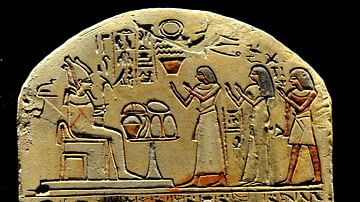
Stela of Khai
Limestone stela of Khai, the follower of the king. From modern-day Egypt. New Kingdom, 18th Dynasty, circa 1400 BCE. (State Museum of Egyptian Art, Munich, Germany).
Image
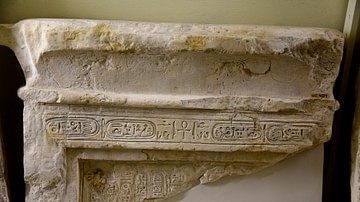
Stela of Akhenaten
This is the upper part of a limestone stela (with a cavetto cornice). There is a 1 line of horizontal hieroglyphic inscriptions, reading symmetrically from the center of the line; early cartouches of Aten can be recognized...
Image
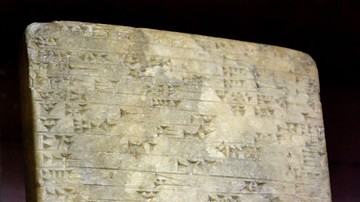
Stela of Shalmaneser I
Stone stela of the Assyrian king Shalmaneser I, reigned 1273-1244 BCE. The Akkadian inscription mentions how the king rebuilt one of the gateways at the city of Ashur. From Ashur, northern Mesopotamia, Iraq. Middle-Assyrian...
Image
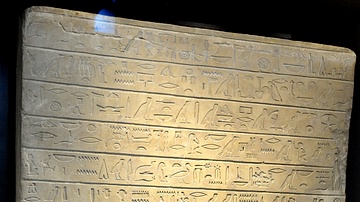
Stela of Sobeki
Limestone stela of the Egyptian nomarch Sobeki. From Abydos, modern-day Egypt. Middle Kingdom, 12th Dynasty, circa 1900 BCE. (State Museum of Egyptian Art, Munich, Germany).
Image
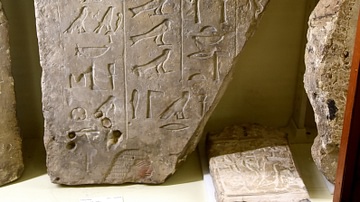
Stela of Idi from the Old Kingdom of Egypt
Only this part of a large limestone stela has survived. At the lower end, there is a head of a man with a beard (originally painted with red). The hieroglyphic inscriptions read "the head lector priest, sole...

Image
Stela of Hesu from the Old Kingdom of Egypt
This limestone stela bears a sunk relief of a man. The man is standing and right-facing; he holds staves. At the lower right corner, a smaller scale figure of woman appears; she wears a a long dress and holds...

Image
Stela of Scribe Amenemhat
Kneeling statue of Amenemhat, holding a stela and praying to the sun. He was the scribe of the grain of Amun. Limestone. New Kingdom, 18th Dynasty, reign of Amenhotep III, 1388-1351 BCE. From Egypt, precise provenance...

Image
Stela of the God Hadad
This basalt stela of the storm god Hadad of Aleppo was brought to the palace museum of King Nebuchadnezzar II as war booty. From Babylon, modern-day Iraq. Late Hittite period, 9th century BCE. (Istanbul Archaeological Museums/Ancient...
