
Search
Did you mean: Sulla?
Remove Ads
Advertisement
Search Results

Image
Stela of the God Hadad
This basalt stela of the storm god Hadad of Aleppo was brought to the palace museum of King Nebuchadnezzar II as war booty. From Babylon, modern-day Iraq. Late Hittite period, 9th century BCE. (Istanbul Archaeological Museums/Ancient...

Image
Stela of Renefseneb
Rectangular painted limestone stela of Renefseneb. It records the traditional prayer in Middle Egyptian for an invocation offering (bread and beer), whereby the recitation of the words would provide sustenance for the deceased...
Image
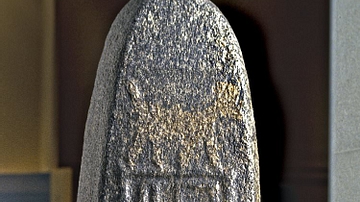
Stela of Peribsen
Granite stela of Peribsen, 2nd Dynasty ruler of Egypt. The inscription consists of the serekh of Peribsen surmounted by the animal of Seth, the latter having been hammered out at a later date.
Image
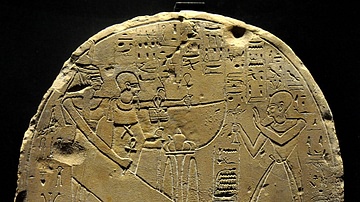
Stela of Kaha
Limestone stela of the head sculptor Kaha. From Deir El-Madinah, Western Thebes, modern-day Egypt. New Kingdom, 20th Dynasty, circa 1150 BCE. (State Museum of Egyptian Art, Munich, Germany).
Image
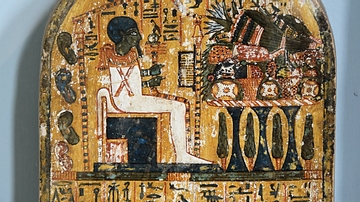
Stela of Penbuy
The upper scene depicts the god Ptah sitting on a throne before an altar of offerings. Ptah has a green-colored face and hands, while his cap is blue and the the rest of the body is white. He has a black beard. In the lower scene...
Image
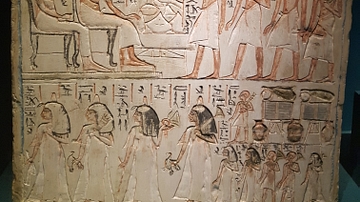
Stela Of Qeh
Stela of Qeh, early 19th Dynasty, about 1250 BCE. Probably from Abydos, Egypt. The British Museum, (photo taken at The Powerhouse Museum, Sydney, Australia) Priests made offerings of food and drink to both the gods and the dead...
Image
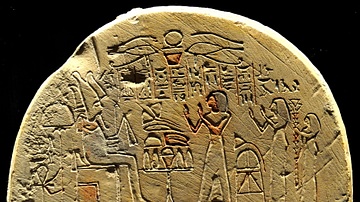
Stela of Nemu
Limestone stela of Nemu, scribe of the divine book; a close-up view of the upper part. From modern-day Egypt. New Kingdom, 18th Dynasty, circa 1400 BCE. (State Museum of Egyptian Art, Munich, Germany).

Image
Stela of Hernán Pérez VI from Bronze Age Iberia
This granite stela dates from the Early or Middle Bronze Age. It was discovered in Cáceres, Spain. (Museo Arqueológico Nacional, Madrid)
Image
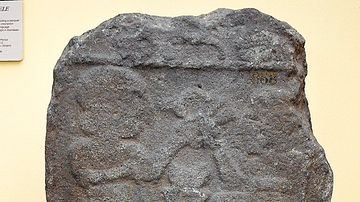
Stela from Ördek-Burnu
The inscriptions on this basalt stela, which depicts a banquet scene, were Hittite hieroglyphic but the script itself was Aramaean. From Ördek-Burnu (modern-day Sinjerli, Gaziantep, Turkey). Late Hittite period, 9th century...
Image
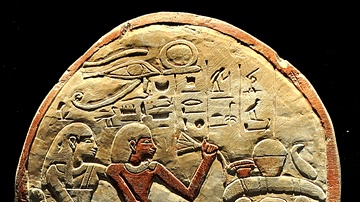
Stela of Penre
Limestone stela of the royal stonecutter Penre. New Kingdom, 18th Dynasty, 1500 BCE. (State Museum of Egyptian Art, Munich, Germany).
