
Search
Did you mean: Sulla?
Remove Ads
Advertisement
Search Results
Image
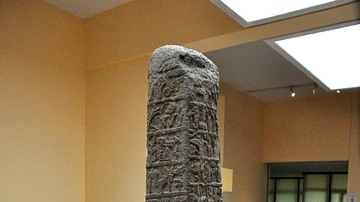
Stela from Izgin
This limestone stela was written with hieroglyphic inscriptions. From Izgin (modern-day Elbistan, Turkey). Late Hittite period, 10th century BCE. (Istanbul Archaeological Museums/Ancient Orient Museum, Istanbul, Turkey).
Image
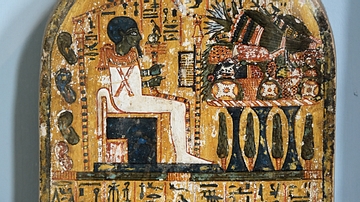
Stela of Penbuy
The upper scene depicts the god Ptah sitting on a throne before an altar of offerings. Ptah has a green-colored face and hands, while his cap is blue and the the rest of the body is white. He has a black beard. In the lower scene...
Image
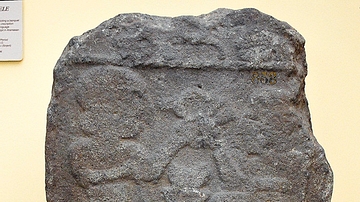
Stela from Ördek-Burnu
The inscriptions on this basalt stela, which depicts a banquet scene, were Hittite hieroglyphic but the script itself was Aramaean. From Ördek-Burnu (modern-day Sinjerli, Gaziantep, Turkey). Late Hittite period, 9th century...
Image
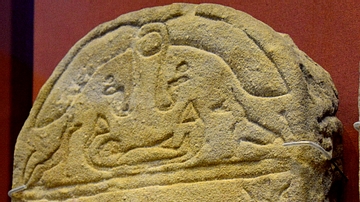
Stela Showing a Deceased Conducted to Osiris
This stela shows that the deceased mummy is being conducted to Osiris by Anubis and Hathor. The inscription below the scene is in Demotic script. From Egypt, precise provenance of excavation is unknown...
Image
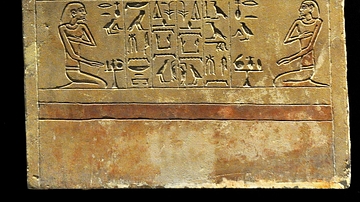
Stela of Nefernay
Limestone stela of Nefernay with his nurse and family. From modern-day Egypt. Middle Kingdom, circa 12th Dynasty, circa 1800 BCE. (State Museum of Egyptian Art, Munich, Germany).

Image
Stela of Sobeknakht, Amarna
Calcite/alabaster stela of the hereditary prince Sobeknakht. From the quarries of Amarna, modern-day Egypt. New Kingdom, 18th Dynasty, 1380 BCE. (State Museum of Egyptian Art, Munich, Germany).

Image
Stela of Hernán Pérez VI from Bronze Age Iberia
This granite stela dates from the Early or Middle Bronze Age. It was discovered in Cáceres, Spain. (Museo Arqueológico Nacional, Madrid)
Image
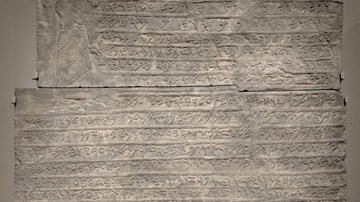
Stela of Kulamuwa with Phoenician Inscription
Plaster mould of a stela found in Sam'al (modern Zincirli, Turkey), dated to 825 BCE. It shows king Kulamuwa alongside a long inscription in Phoenician writing. In his left hand, the king holds a lotus...
Image
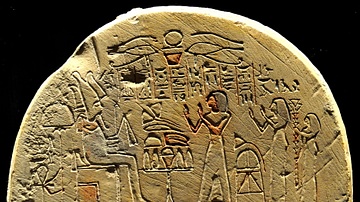
Stela of Nemu
Limestone stela of Nemu, scribe of the divine book; a close-up view of the upper part. From modern-day Egypt. New Kingdom, 18th Dynasty, circa 1400 BCE. (State Museum of Egyptian Art, Munich, Germany).

Image
Stela of Amunherhetef
Limestone stela of Amunherhetef, the fan-bearer. From modern-day Egypt. New Kingdom, 18th Dynasty, circa 1380 BCE. (State Museum of Egyptian Art, Munich, Germany).
