
Search
Did you mean: Sulla?
Remove Ads
Advertisement
Search Results
Image
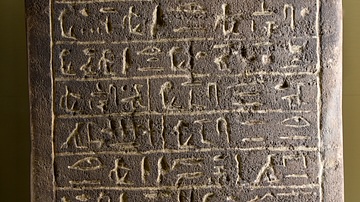
Egyptian stela of Sehetepibre and others
On this sandstone stela, there are 10 lines of hieroglyphs inside the border line. The stela mentions the name of the guard of the bureau of fields, Sehetepibre (born of Ite). From the Tombs of The Courtiers...

Image
Ra-Horakhty Stela
This painted stela shows the seated falcon-headed Ra-Horakhty. Ra-Horakhty combines the sun god Ra with Horus, the sky god, and is believed to coincide with the popularity of sun worship in ancient Egypt. From Thebes, Egypt...

Image
Roman Funerary Stela from Zurich
A father had this tombstone erected in memory of his little boy Lucius, who had died at the age of two. The inscription in Latin not only mentions the profession of the man, who was head of the Zurich customs post...
Image
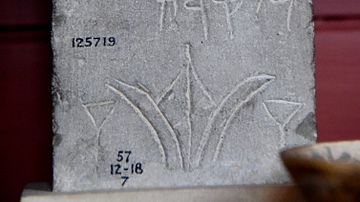
Phoenician Stela Dedicated to Tanit & Baal-Hammon
This light grey limestone stela was inscribed with six lines of Phoenician/Punic inscription; the upper line is almost lost. There is a lotus flower flanked by two standards at the lower part. There...

Image
Warrior Stela from Bronze Age Iberia
This stela is from Solana de Cabañas (Cabañas del Castillo, Cáceres), Spain and dates from the Late Bronze Age. It is made of slate, and it was unearthed in the late 19th century CE. This was the first specimen...
Image
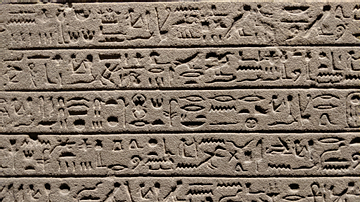
Hieroglyphics from the Bakhtan Stela
Close-up of the Bakhtan Stela showing hieroglyphic writing. 21st Dynasty of Egypt, c. 1073-1064 BCE.
Image
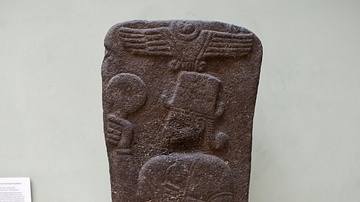
Hittite Basalt Stela Showing Goddess Kubaba
The upper part is a freestanding basalt monument depicting the goddess Kubaba, consort of the storm god Teshub, and one of the most important deities at Carchemish. She holds a mirror and pomegranate, symbols...
Image
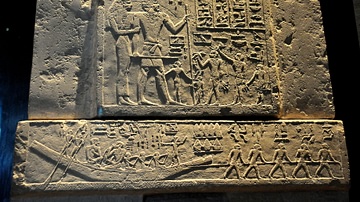
False-Door Stela of Meni
Limestone fragments of the false-door stela of the tomb of Meni. From Giza, modern-day Egypt. Old Kingdom, 6th Dynasty, circa 2200 BCE. (State Museum of Egyptian Art, Munich, Germany).
Image
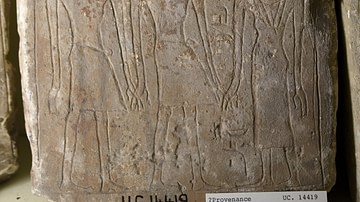
Egyptian Stela of Neferhotep
On this limestone stela, the hieroglyphic inscriptions mention the name of the Overseer of Cattle Neferhotep, son of the Overseer of Cattle Dednub and the chantress Itires. On the lower right border, a standing woman...
Image
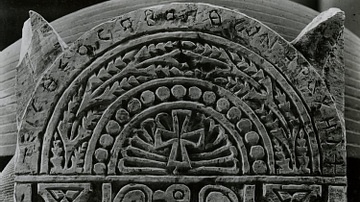
Byzantine Funerary Stela
Found in Egypt, this limestone funerary stela, dating to 6th or 7th century CE, depicting a cross above a dove. The Greek inscription reads, "Single God, helping Rachel". Measures 57.4 cm in height, 42.5 cm in width.
