
Search
Did you mean: Sulla?
Remove Ads
Advertisement
Search Results

Image
Egyptian stela from Intef blocks at a temple precinct
On this fragment of a limestone stela, a man sits, facing to the right; behind him, a trace of a women appears. The hieroglyphs mention a reference to an acquisition of three different kinds of animals...
Image
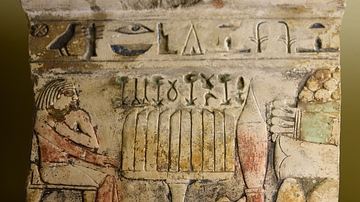
Egyptian stela of offering
This is a part of a painted limestone stela with different colors. A man sits on a lion-legged chair before offerings and a offering table. There is one line of hieroglyphic inscription at the upper part with offering...
Image
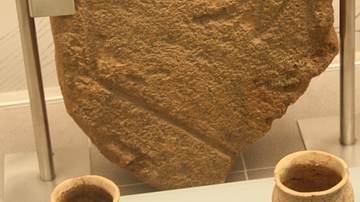
Iberian Funeral Stela
An Iberian funeral stela from Empuries. The design shows a a coiled iron spear or soliferreum, an action which was customary on burial. 6th century BCE. (Archaeological Museum, Empuries, Spain)
Image
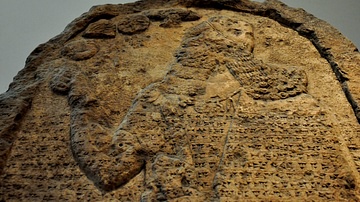
Kurkh Stela of Shalmaneser III
This is a close-up view of the upper part of the stela, depicting Shalmaneser III praying in front of divine symbols (Ashur, Ishtar, Anu, and Sin). The cuneiform inscription is a text of a version of the King's annals...
Image
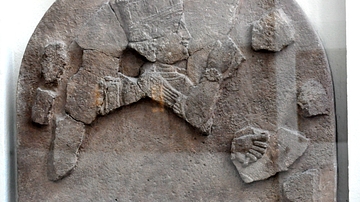
Ashur-Sharrat Stela
These fragments were part of a stela which was found at the Row of Stelae in the city of Ashur. It depicts a woman who wears a crown in the shape of a crenelated city wall. This is queen Ashur-Sharrat, wife of Ashurbanipal...
Image
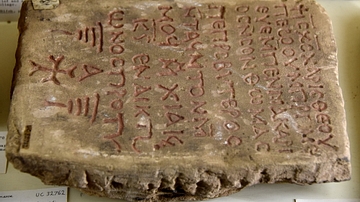
Coptic Stela
This sandstone stela was carved with Coptic inscriptions commemorating "Our Brother Thomas The Presbyter". From Egypt. 5th to 7th centuries CE.The Petrie Museum of Egyptian Archaeology, London (with thanks to The Petrie Museum of...

Image
Tomb Niche & Stela of Chnumit
Limestone tomb niche with a false-door stela and 2 side walls. From the tomb of princess Chnumit (also written Khnumet), Saqqara (Sakkara), modern-day Egypt. Old Kingdom, 6th Dynasty, circa 2200 BCE. (State Museum of...
Image
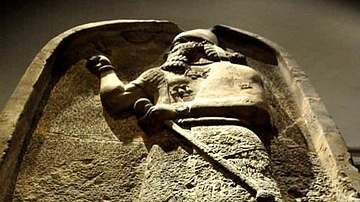
Gypsum Stela of Ashurnasirpal II
The Assyrian king worships gods (Ashur, Shamash, Sin, Adad, and Ishtar) and records his achievements. This freestanding gypsum monument was erected by King Ashurnasirpal II (reigned 883-859 BCE). This stela weighs...

Image
Grave Stela of Exakestes
This is a marble grave stela of Exakestes, son of Androboulos, and his wife Metries. The deceased are shown in the pedimental arch (naiskos), upon which are carved two wreaths inscribed "The People". These indicate that...
Image
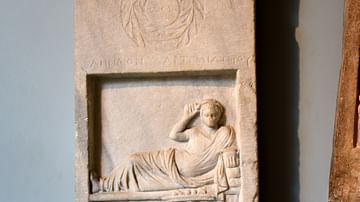
Grave Stela of Lenaios
This is a marble grave stela of Lenaios, son of Artemidoros. The deceased image is shown as a banqueter, which belies in his military occupation in life, as indicated in the inscription "As I guarded the tower in battle...
