
Search
Did you mean: Sulla?
Remove Ads
Advertisement
Search Results
Image
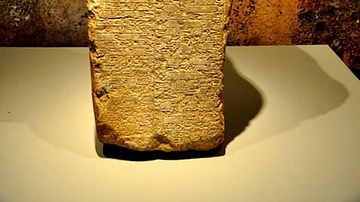
Stela of Iddi-Sin, King of Simurrum
The stela of Iddi-Sin, King of Simurrum celebrates and commemorates the victories of this King against his enemies, mostly tribes of West Iran. The stela is carved with 108 lines of cuneiform inscriptions and was...

Image
Stela of Parthenios
This sandstone stela was made in what is present-day Egypt around 66 CE. The script is in Demotic. Parthenios oversaw the finances at the Temple of Isis in Koptos (modern Qift, Egypt) from c. 18-63 CE. This stela details an...
Image
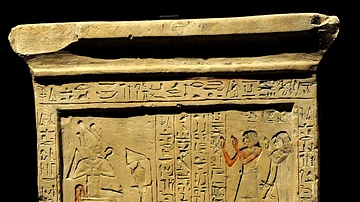
Stela of Pairi
Limestone stela of Pairi. The stela was re-used again by Nefery. From modern-day Egypt. New Kingdom, 18th Dynasty, circa 1300 BCE. (State Museum of Egyptian Art, Munich, Germany).

Image
Stela Of Padikhered & Tasherimehet
Stela Of Padikhered and Tasherimehet, Ptolemaic Period, 332-30 BCE. Found in Akhmim, Egypt. The British Museum (photo taken at The Powerhouse Museum, Sydney, Australia). This double stela was carved for two...

Image
Stela of Shamshi-Adad V
The limestone Stela of Shamshi-Adad V. Neo-Assyrian, 815-811 BCE. The king is shown giving a gesture of blessing before five divine symbols: Anu's three-horned crown (top), a winged-disk, disk and crescent, fork, and Ishtar's...

Image
Stela of Kamose
Kamose of Thebes sacked Avaris in an attempt to unify Egypt and drive out foreign kings c. 1575 BCE, Second Intermediate Period of Egypt. Stela on display in the Luxor Museum, Egypt.

Image
Stela of Ptahmay
Limestone stela of the chief of police, Ptahmay. From modern-day Egypt. New Kingdom, 18th Dynasty, circa 1300 BCE. (State Museum of Egyptian Art, Munich, Germany).

Image
Stela of Roy and Kashisha
Limestone stela of the priest Roy and standard-bearer Kashisha. From modern-day Egypt. New Kingdom, 18th Dynasty, circa 1420 BCE. (State Museum of Egyptian Art, Munich, Germany).
Image
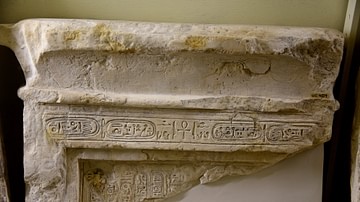
Stela of Akhenaten
This is the upper part of a limestone stela (with a cavetto cornice). There is a 1 line of horizontal hieroglyphic inscriptions, reading symmetrically from the center of the line; early cartouches of Aten can be recognized...
Image
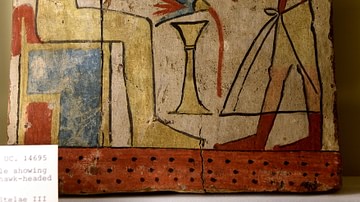
Stela of Ihefy & Horus
This painted wooden stela depicts a man (his name is identified as Ihefy and his title was "the doorkeeper of the house of Amun") adoring the hawk-headed god Horus. Horus sits on a throne and holds a flail. There is a red...
