
Search
Remove Ads
Advertisement
Search Results

Definition
Tyre
Tyre (in modern-day Lebanon) is one of the oldest cities in the world, dating back over 4,000 years, during which it has been inhabited almost continuously. It was one of the most important, and at times the dominant, city of Phoenicia...
Image
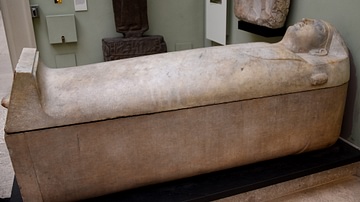
Phoenician Coffin from Sidon
This white marble anthropoid (human-shaped) coffin shows a male head wearing a Egyptian style headdress. Phoenician art was influenced by many different traditions. Coffins of this Gaeco-Egyptian style have been found...

Definition
Portuguese Angola
Portuguese Angola in southwest Africa was the first European colony on that continent. While settlement from 1571 proved problematic in the interior, the Portuguese did obtain a large number of slaves which they shipped to their...

Article
Top 5 Archaeological Sites in Lebanon
Home to some of the Middle East’s most majestic ancient ruins, Lebanon has a rich and varied heritage with over 5,000 years of recorded history. Over the millennia, different conquering empires have left their...
Image
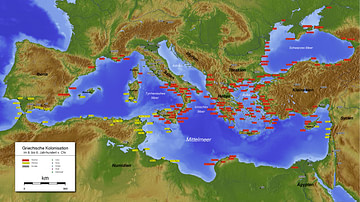
Greek & Phoenician Colonies
Greek (Red) and Phoenician (Yellow) colonization between the 8th and the 6th century BC.
German placenames.

Image
Phoenician-Punic Grinning Mask
Phoenician grinning mask, 4th century BCE, found in a grave at San Sperate in Sardinia. Masks like these were used to ward off evil. (Cagliari Museo Archeologico Nazionale)

Image
Phoenician Glassware
Two Phoenician coloured glass vessels. 5th-3rd century BCE. (Museum kunst Palast, Dusseldorf)

Image
Phoenician Ivory Sphinx Plaque
This ivory plaque is part of the so-called "Nimrud Ivories." The sphinx wears the typical Egyptian Pharaohs' double crown and an apron with cobra. This indicates that the plaque was made by a Phoenician craftsman...
Image
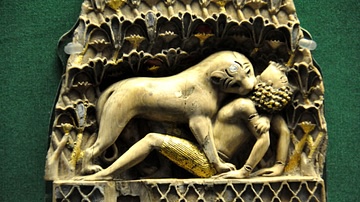
Lioness Devouring a Boy, Phoenician Ivory Panel
This Phoenician carved ivory panel is one of an almost identical pair with one now in the Iraq Museum, Baghdad. They originally formed part of a piece of furniture, perhaps a throne. The incised letter...
Image
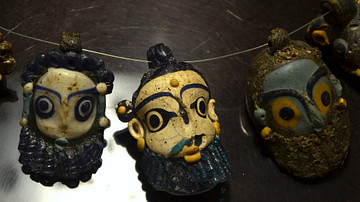
Phoenician/Punic Necklace with Amulets
Phoenician or Carthaginian amulets in the form of bearded heads made of sand-core glass, 4th-3rd century BCE (Cagliari, Museo Archeologico Nazionale).
