
Search
Remove Ads
Advertisement
Search Results
Image
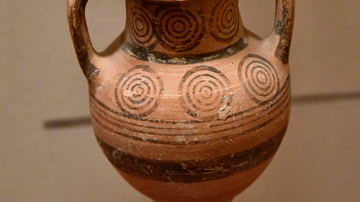
Cypro-Phoenician Pottery Vessel
This vessel belongs to a ceramic tradition known as "black-on-red" ware, the most ubiquitous of the Iron Age's Cypro-Phoenician exports. Iron Age II, 1000-539 BCE. From Amman, Jordan. (The Jordan Museum, Amman, Jordan...
Image
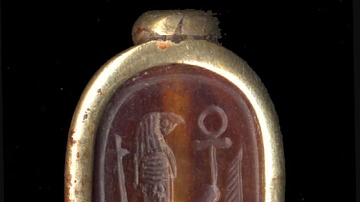
Phoenician Scarab Seal
A Phoenician carved scarab seal (sard and gold) depicting the hawk of Horus holding an ankh and a feather of Maat. 750-500 BCE. (British Museum, London)
Image
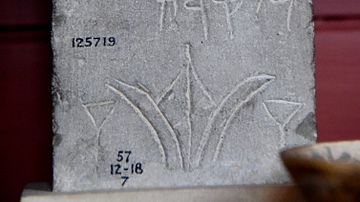
Phoenician Stela Dedicated to Tanit & Baal-Hammon
This light grey limestone stela was inscribed with six lines of Phoenician/Punic inscription; the upper line is almost lost. There is a lotus flower flanked by two standards at the lower part. There...
Image
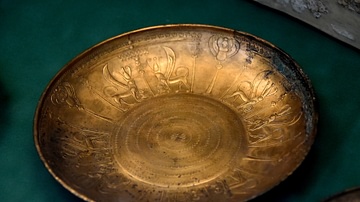
Phoenician Bronze Bowl From Nimrud
This bowl was part of a hoard found by Sir Henry Layard in 1850-1851 CE in the North-West Palace at Nimrud (ancient Kalhu). They were probably deposited there in the 8th century BCE. The decoration on the bowls...

Image
Head of a Phoenician Woman
This is a head of woman wearing an Egyptian wig. The hole at the top is a hole for suspension. Part of a baked clay votive figure. The Canaanite traditions of terracotta figurine manufacturer were continued by the Phoenicians...
Image
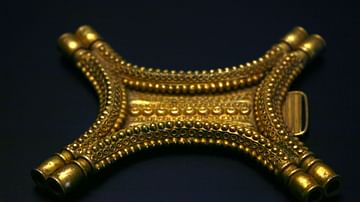
Phoenician-Punic Gold Pectoral
A Phoenician-Punic gold pectoral, 8th-7th Century BCE. From the El Carambolo Treasure, Seville. (National Archaeological Museum, Madrid)
Image
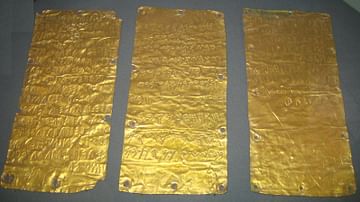
Etruscan & Phoenician Inscriptions
Gold sheet plaques from Pygri, the port of Etruscan Cerveteri. In both the Etruscan and Phoenician alphabet they describe the separation of a space dedicated in the temple there for Astarte. c. 500 BCE (Museo di...
Image
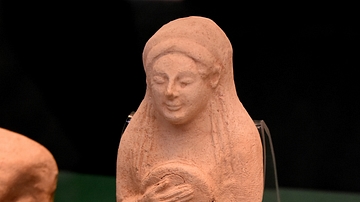
Phoenician Tambourine Player from Tharros
This is a baked clay votive figurine of woman playing a tambourine. The curls of her hair show a Greek influence. The Canaanite traditions of terracotta figurine manufacturer were continued by the Phoenicians...
Definition
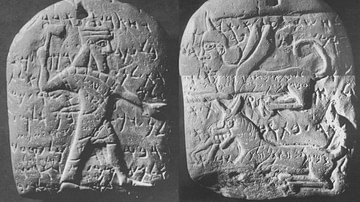
Arslan Tash Amulet
Dated to the 7th century BCE, the Arslan Tash amulet (AT1) was discovered in Arslan Tash, Syria and contains the writing of Phoenician, magic incantations. The limestone plaque includes a variety of features: incantations perceived...

Collection
Trade & Commerce in Ancient Greece
The ancient Mediterranean was a busy place with trading ships sailing in all directions to connect cities and cultures. The Greeks were so keen on the rewards of trade and commerce that they colonized large parts...
