
Search
Remove Ads
Advertisement
Search Results

Definition
Seven Lucky Gods
In Japanese folklore the Shichifukujin are the Seven Lucky Gods who may also be known as the Seven Gods of Happiness or the Seven Gods of Good Fortune. The seven gods are in fact of diverse origin as some are originally from Buddhism...

Definition
Western Roman Empire
The Western Roman Empire is the modern-day term for the western half of the Roman Empire after it was divided in two by the emperor Diocletian (r. 284-305 CE) in c. 285/286 CE. The Romans themselves did not use this term...
Definition
Constantine VI
Constantine VI, also known as Constantine "the Blinded”, was emperor of the Byzantine Empire from 780 to 797 CE, although for most of his reign his mother, Irene the Athenian, ruled as regent. When Constantine did finally get a...

Definition
Toyotomi Hideyoshi - Unifier of Japan
Toyotomi Hideyoshi (1537-1598) was a Japanese military leader who, along with his predecessor Oda Nobunaga (1534-1582) and his successor Tokugawa Ieyasu (1543-1616), is credited with unifying Japan in the 16th...

Definition
Shogun
The shoguns of medieval Japan were military dictators who ruled the country via a feudal system where a vassal's military service and loyalty was given in return for a lord's patronage. Established as an institution by the first shogun...
Image
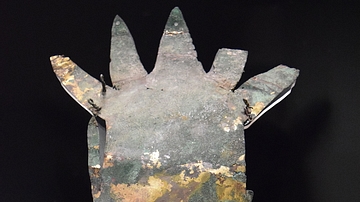
Japanese Gilt Bronze Crown
A gilt bronze crown. Nihon Matsuyama Tumulus, Eiheiji-cho, Yoshida-gun, Fukui, Japan. Kofun Period, 5th century CE. (Tokyo National Museum)
Image
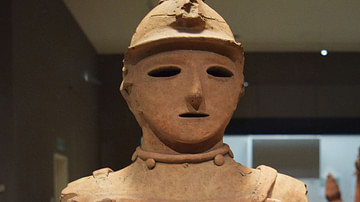
Japanese Haniwa Warrior
This haniwa warrior in tanko armor is a terracotta tomb figurine. It comes from Kamichujo in Saitama prefecture, Japan. It dates from the 5th-6th century CE, during the Kofun period. Important cultural property. (Tokyo National...
Image
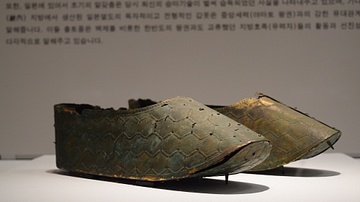
Japanese Gilt Bronze Shoes
Gilt bronze shoes, most likely imports from the Korean Peninsula. Etafunayama Tumulus, Nagomi-machi, Kumamoto, Japan. Kofun Period, 5th-6th century CE. National Treasure. (Tokyo National Museum)

Image
Fragment of a Japanese Bodhisattva Head
This fragment of a wooden bodhisattva head comes from Japan and was made during the Kamakura Period during the 13th century CE. (Museum Rietberg, Zürich).

Image
Map of Medieval Japanese Trade & Wako Pirates
Map depicting Medieval Japan and its trade relations with its neighbours, China and Korea. The map shows the major trade goods exchanged between Japan, China, and Korea. Black lines show the approximate...
