
Search
Remove Ads
Advertisement
Search Results

Definition
Angkor Wat
Angkor Wat is a temple complex in the province of Siem Reap, Cambodia originally dedicated to the Hindu god Vishnu in the 12th century CE. It is among the largest religious buildings ever created, second only to the Temple of Karnak...

Definition
Surya
Surya (also known as Aditya) is the Hindu god of the Sun. He is considered the creator of the universe and the source of all life. He is the supreme soul who brings light and warmth to the world. Each day he travels across the sky in...

Definition
Krishna
Krishna (Krsna or Hari Krishna) is a major god of the Hindu pantheon and considered the eighth incarnation of Vishnu. He is perhaps the most popular of all the heroes of Hindu mythology. Krishna's adventures appear in the Mahabharata...

Definition
Soma - The Elixir of the Hindu Gods
Soma was a fermented juice drink which was believed to have been consumed by the Hindu gods and their ancient priests, the brahmanas, during rituals. Thought to be an elixir its consumption not only healed illness...

Definition
Upanishads
The Upanishads are the philosophical-religious texts of Hinduism (also known as Sanatan Dharma meaning “Eternal Order” or “Eternal Path”) which develop and explain the fundamental tenets of the religion. The name is translated as...

Definition
Thomas Hobbes
Thomas Hobbes (1588-1679) was an English philosopher who famously summarised his pessimistic view of human nature in his greatest work, Leviathan, published in 1651. Hobbes believed that the life of humanity in the state of nature...
Definition
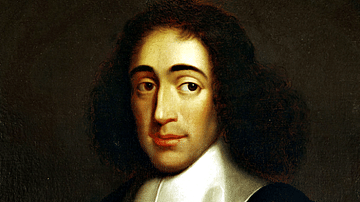
Baruch Spinoza
Baruch Spinoza (1632-1677) was a Dutch philosopher who combined rationalism and metaphysics to create a unique system of thought. Spinoza was held up as an atheist philosopher in the 18th century, but this is not an entirely accurate...

Definition
Empedocles
Empedocles (l. c. 484-424 BCE) was a Greek philosopher and mystic whose work harmonized the philosophies of Parmenides (l. c. 485 BCE), Heraclitus (l. c. 500 BCE), and Pythagoras (l. c. 571 to c. 497 BCE) in presenting a unified vision...

Definition
Zeno of Elea
Zeno of Elea (l. c.465 BCE) was a Greek philosopher of the Eleatic School and a student of the elder philosopher Parmenides (l.c. 485 BCE) whose work influenced the philosophy of Socrates (l. c. 470/469-399 BCE). Zeno and Parmenides...

Article
Marcus Aurelius: Plato's Philosopher King
Plato's concept of the Philosopher-King (one who governs according to philosophical precepts and higher truths) is thought to be best exemplified through the Roman emperor Marcus Aurelius Antoninus (r. 161-180...
