
Search
Remove Ads
Advertisement
Search Results

Definition
Yin and Yang
The principle of Yin and Yang from Chinese philosophy is that all things exist as inseparable and contradictory opposites. Examples of Yin-Yang opposite forces are female-male, dark-light, and old-young. The pairs of equal opposites...

Definition
Xenophanes of Colophon
Xenophanes of Colophon (l. c. 570 to c. 478 BCE) was a Greek philosopher born 50 miles north of Miletus, a city famed for the birth of philosophy and home to the first Western philosopher, Thales of Miletus (l. c. 585 BCE...

Definition
Anaximander
Anaximander of Miletus (l. c. 610 - c. 546 BCE) was one of the early Pre-Socratic Philosophers who lay the foundation for the deveopment of Western Philosophy. He was a student of Thales of Miletus (l. c. 585 BCE), recognized as the...
Article
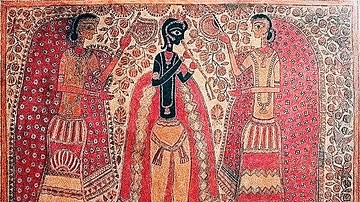
Madhubani Paintings: People’s Living Cultural Heritage
Mithila, a region in the state of Bihar, northern India (and also stretching into Nepal), has an important tradition of knowledge in the form of paintings. Madhubani paintings (also known as Mithila...

Article
Religious Developments in Ancient India
For well over 1,000 years, sacred stories and heroic epics have made up the mythology of Hinduism. Nothing in these complex yet colourful legends is fixed and firm. Pulsing with creation, destruction, love...

Definition
Anglo-Maratha Wars
The three Anglo-Maratha Wars (1775-1819) were fought between the Maratha Confederacy of India (aka the Mahrattas, 1674-1818) and the British East India Company (EIC). The Maratha Hindu princes were rarely unified, and so the...

Definition
Nandi
Nandi (also Nandin) is the sacred bull calf, gatekeeper, and vehicle (vahana) of the Hindu god Shiva. Sculptures of Nandi are a common sight at Hindu temples dedicated to his master, and he is partly responsible for the Hindu reverence...

Definition
Siddhartha Gautama
Siddhartha Gautama (better known as the Buddha, l. c. 563 - c. 483 BCE) was, according to legend, a Hindu prince who renounced his position and wealth to seek enlightenment as a spiritual ascetic, attained his goal and, in preaching...

Definition
Ibadat Khana
The House of Worship or the Ibadat Khana was established by Mughal Emperor Akbar (1542-1605 CE) for conducting religious debates and discussions among theologians and professors of different religions. Abu'l-Fath Jalal-ud-din Muhammad...
Definition
Karma
Karma is a Sanskrit word that primarily means 'action' but for South Asian Religions (and Philosophy) it is not limited to that as the term has gained various meanings and connotations over time. The term karma connects actions and results...
