
Search
Remove Ads
Advertisement
Search Results

Definition
Lakshmi
Lakshmi (or Laksmi) is the Hindu goddess of wealth, good fortune, youth, and beauty. She is the wife of the great god Vishnu and the pair is often worshipped in tandem as Lakshmi-Narayana. Just as her husband has many avatars when he...

Definition
Atalanta - The Huntress of Greek Mythology
Atalanta is a figure from Greek mythology famed as a huntress, wrestler, and runner. The heroine was a key participant in the Calydonian boar hunt, striking the first wound in this fearsome beast with her bow...

Definition
Early Joseon Period
The Early Joseon Period (1392 - c. 1550 CE) in Korea was bookended by internal power struggles but witnessed major scientific and societal advances and prosperity. The Joseon (Choson) Dynasty ruled Korea from 1392 CE to 1897...

Definition
Goguryeo
Goguryeo (Koguryo) was a kingdom which ruled northern Korea during the Three Kingdoms period from the 1st century BCE to 7th century CE. The kingdom flourished in the 5th and 6th century CE and has left a rich cultural heritage best...

Definition
Quran
The Quran (also written Qur’an or Koran), revealed in the 7th century, is the sacred book of Islam, following in the tradition of the Abrahamic faiths, with the Torah as the sacred book of Judaism and the New Testament as the sacred book...

Definition
Sphinx
A sphinx is a mythical creature with the body of a lion, most often with a human head and sometimes with wings. The creature was an Egyptian invention and had a male head - human or animal; however, in Greek mythology, the creature had...
Definition
Pankration
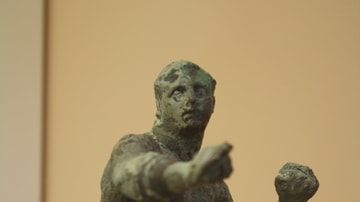
Pankration is an ancient martial art which mixes wrestling and boxing. The sport can be traced as far back as the second millennium BCE in the territory of ancient Greece. Its name derives from the ancient Greek words pan (all) and...

Definition
Three Kingdoms Period in Korea
The Three Kingdoms Period of ancient Korea (57 BCE – 668 CE) is so-called because it was dominated by the three kingdoms of Baekje (Paekche), Goguryeo (Koguryo), and Silla. There was also, though, a fourth entity...

Definition
Leto
Leto is a Titan and the mother of the gods Apollo and Artemis in Greek mythology. Leto's twin children were the result of an amorous encounter with Zeus, and to avoid his wife Hera's wrath, the Titaness was obliged to give birth on the...

Definition
Hephaistos
Hephaistos (Hephaestus) was the ancient Greek god of fire, metallurgy, and crafts. He was the brilliant blacksmith of the Olympian gods, for whom he fashioned magnificent houses, armour, and ingenious devices. Hephaistos had his workshop...
