
Search
Remove Ads
Advertisement
Search Results

Definition
Hestia
Hestia was the Greek virgin goddess of the hearth, home, and hospitality. In Greek mythology, she is the eldest daughter of Cronus and Rhea. In her role as a protector of the family and political community, sacrifices and offerings were...

Definition
Satyr
Satyrs (aka silens) are figures from Greek mythology who were followers of the god of wine Dionysos. Satyrs were often guilty of excessive sexual desires and overindulgence of wine. Men with a horse's tail and ears or men with goat legs...

Definition
Marcus Agrippa
Marcus Vipsanius Agrippa (l. 64/62 – 12 BCE) was Augustus' (r. 27 BCE - 14 CE) most trusted and unshakably loyal general and his right-hand man in the administration of the city of Rome. Although his name is forever connected with...

Definition
Etruscan Religion
The religion of the Etruscans, the civilization which flourished from the 8th to 3rd century BCE in central Italy, has, like many other features of the culture, long been overshadowed by that of its Greek contemporaries and Roman...

Definition
Crucifixion
Crucifixion as a punishment was practiced by several ancient cultures, but most notably adopted by the Roman Republic and later Roman Empire. Crucifixion was a method of hanging or suspending someone on the combination of vertical...

Image
Jain art
Marble carving in a Jain temple complex located in Ranakpur, Rajasthan, India.

Video
3D Digital Art Ancient Nineveh - Ashurbanipal, Assyria
Ancient Assyrian city of Nineveh shown in almost real-time (in modern day Iraq, Assyria Regional Governorate)

Image
De Re Coquinaria ('The Art of Cooking')
1541 CE manuscript of Apicius' De Re Coquinaria - a Roman cookbook - here named De Re Culinaria.

Image
Rainbow Serpent Art
Rainbow Serpent by John Mawurndjul, 1991.
Musée du quai Branly, Paris.
Definition
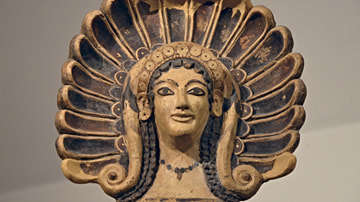
Etruscan Pottery
Etruscan pottery, produced over five centuries, was nothing if not varied. Indigenous wares such as the glossy black bucchero were made alongside red- and black-figure pottery imitating, yet modifying those produced in the Greek...
