
Search
Remove Ads
Advertisement
Search Results

Definition
Persepolis
Persepolis was the capital of the Persian Achaemenid Empire from the reign of Darius I (the Great, r. 522-486 BCE) until its destruction in 330 BCE. Its name comes from the Greek Perses-polis (Persian City), but the Persians knew...

Definition
Pietro Perugino
Pietro Perugino (c. 1450-1523), real name Pietro di Cristoforo Vannucci, was an Italian Renaissance artist who created frescoes for the Vatican's Sistine Chapel and was in demand across Italy to decorate church interiors and produce...

Definition
Helios
Helios (also Helius) was the god of the Sun in Greek mythology. Helios rode a golden chariot which brought the Sun across the skies each day from the east (Ethiopia) to the west (Hesperides). Helios was famously the subject of the Colossus...
Definition
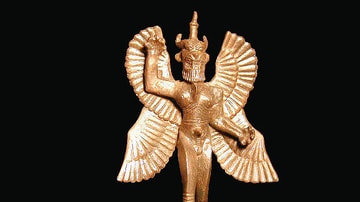
Pazuzu - The Mesopotamian Demon of Destruction and Protection
Pazuzu is a Babylonian/Assyrian demon who was most popular in the first millennium BCE. He was the son of Hanbi (also Hanba), king of the demons of the underworld, and brother of Humbaba, the...

Definition
Late Period of Ancient Egypt - The End of Egyptian Rule of Egypt
The Late Period of Egypt (525-332 BCE) is the era following the Third Intermediate Period (1069-525) and preceding the brief Hellenistic period (332-323 BCE) when Egypt was ruled by the Argead...

Definition
Greco-Bactrian Kingdom
The Greco-Bactrian kingdom refers to several dynasties and probably kingdoms of Greco-Macedonian monarchs who ruled over Bactria from 250 to 130 BCE. Foundation The Greco-Bactrian kingdom appeared in 250 BCE, when the...

Definition
Atlas - The Greek Titan Who Held up the World
In Greek mythology, the Titan Atlas was responsible for bearing the weight of the heavens on his shoulders, a burden given to him as punishment by Zeus. Father of many stars and a protagonist in one of Hercules'...

Definition
Pan - The Pastoral God of Ancient Greece
Pan is a figure from Greek mythology who was originally a pastoral god from Arcadia. It was believed Pan dwelt in the mountains and forests of Greece. He was the patron of shepherds, hence one of his attributes...

Definition
Ancient Korean Sculpture
The sculpture of ancient Korea was dominated by Buddhist themes such as figurines and monumental statues of the Buddha and his followers, and large bronze bells for temples. Gilded-bronze was the most common material used...

Definition
Hans Holbein the Younger
Hans Holbein the Younger (c. 1497-1543 CE) was a German Renaissance painter who is most famous for his portraits. A versatile artist and superb draughtsman, Holbein was accomplished in different mediums from woodcut engravings...
