
Search
Remove Ads
Advertisement
Search Results
Image
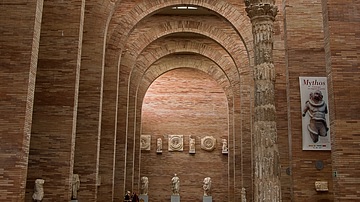
National Museum of Roman Art in Mérida, Spain
Main hall of the National Museum of Roman Art in Mérida (Spanish: Museo Nacional de Arte Romano), Spain. Inaugurated in 1986, the magnificent building, reflecting certain aspects of Roman architecture...

Article
7 Ancient Sites in Georgia
Georgia, lying at the junction of Europe and Asia, is a country of ancient myths with a rich and turbulent history. Home to the first European hominids and the birthplace of wine, Georgia's roots trace back to ancient...

Definition
Homer
Homer (c. 750 BCE) is perhaps the greatest of all epic poets and his legendary status was well established by the time of Classical Athens. He composed (not wrote, since the poems were created and transmitted orally, they were not written...

Definition
Etruscan Architecture
The architecture of the Etruscan civilization, which flourished in central Italy from the 8th to 3rd century BCE, has largely been obliterated both by the conquering Romans and time, but the very influence of the Etruscans...

Definition
La Tène Culture
The La Tène culture (c. 450 - c. 50 BCE) is named after the site of that name on the northern shores of Lake Neuchâtel in Switzerland. It replaced the earlier Hallstatt culture (c. 1200 - c. 450 BCE) as the dominant culture of...

Definition
Cherub
A cherub (pl. cherubim) was a divine being who dwelt in the heavenly realm of the gods, either as a servant or a mediator between humans and the divine. The word most likely derived from the Akkadian karabu ("to bless"). The cherubim...

Definition
Agrigento
Agrigento (Greek: Akragas, Latin: Agrigentum) was a Greek-founded city-state located on the south coast of Sicily near the river Akragas (now S. Biagio) just 5 km from the sea. At its peak, the city may have had as many as 300,000...

Definition
Carthaginian Army
The armies of Carthage permitted the city to forge the most powerful empire in the western Mediterranean from the 6th to 3rd centuries BCE. Although by tradition a seafaring nation with a powerful navy, Carthage, by necessity...

Definition
Thessalonike of Macedon
Thessalonike of Macedon (c. 345-295 BCE) was the daughter of Philip II of Macedon (r. 359-336 BCE) and one of his several consorts, Nikesipolis of Pherae (also spelt Nicesipolis). Born to the Argead family of Macedonian...

Definition
Ancient Greek Science
Ancient Greek science is a modern term for the application of systematic inquiry into the individual, the world, and the universe, which began in Ionia in the 6th century BCE with Thales of Miletus (l. c. 585 BCE) and continued...
