
Search
Remove Ads
Advertisement
Search Results
Image
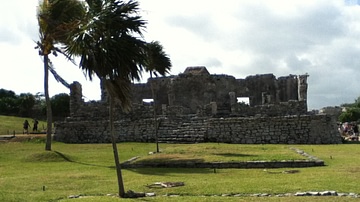
Building 25, Tulum, Mexico
The structure known as Building 25 was possibly part of the administrative complex of the city of Tulum. The city thrived as a trading center between the 11th-16th centuries CE.

Image
The Temple of the Frescoes, Tulum, Mexico
The Temple of the Frescoes dates to around the 11th century CE while the paintings on the walls inside date to 11th-12th centuries CE. A second storey was added later. Two red hand prints can be seen on this...

Definition
Cochineal
Cochineal is a brilliant red dye extracted from the crushed bodies of parasitic insects which prey on cacti in the warmer parts of the Americas. The dye was an important part of trade in ancient Mesoamerica and South America and throughout...

Definition
Aetolian League
The Aetolian League was an ancient Greek alliance of the tribes that lived west of Athens and north of the Peloponnese. The league was probably first established in the early 4th century BCE, reached its peak during the Hellenistic...

Definition
Teotihuacan
Teotihuacan, located in the Basin of Central Mexico, was the largest, most influential, and most revered city in the history of the New World. It flourished in Mesoamerica's Golden Age, the Classic Period of the first millennium CE...

Article
Jade in Mesoamerica
Jade was a highly-esteemed material in many Mesoamerican cultures, making it a valued regional trade good and first choice for objects of religious and artistic value such as masks, ceremonial axeheads, figurines, and jewellery...

Definition
Quetzalcóatl
Quetzalcóatl (pron. Quet-zal-co-at) or 'Plumed Serpent' was one of the most important gods in ancient Mesoamerica. Quetzalcóatl was the god of winds and rain, and the creator of the world and humanity. A mix of bird and rattlesnake...

Image
Map of The Olmec World and Its Mesoamerican Connections - Power, Resources, and Interaction Networks, c. 1500–400 BCE
The Olmec world developed in the tropical lowlands of present-day Veracruz and Tabasco during Mesoamerica’s Formative period (c. 1500–400 BCE). Major...

Definition
Juan de Grijalva
Juan de Grijalva (aka Grijalba, 1489-1527) was a Spanish conquistador who explored the eastern coast of Mexico in 1518. His notable achievements included a demonstration that the Yucatán Peninsula was just that and not, as previously...

Article
Top 5 'Deep-Dive' Virtual Shipwrecks
According to UNESCO, an estimated three million shipwrecks are scattered in the oceans’ deep canyons, trenches, and coral reefs and remain undiscovered. These shipwrecks preserve historical information and provide...
