
Search
Remove Ads
Advertisement
Search Results

Image
Tenochtitlan
The Aztec capital of Tenochtitlan, located on an island on Lake Texcoco in present-day Mexico. The capital was founded in 1345 CE and destroyed in 1521 CE.

Image
Grave Decorations for Day of the Dead
Grave decorations for Day of the Dead, photograph by Eneas De Troya, 2009. Depicted here is a cemetary in San Antonio Tecómitl where the grave plots have been richly adorned for Day of the Dead (Día de los Muertos...

Image
Lake Texcoco
A map of Lake Texcoco and the Valley of Mexico indicating the principal settlements c. 1519 CE, including the Aztec Triple Alliance cities of Tenochtitlan, Texcoco and Tlacopan.

Image
Major Edward W. Wynkoop
Major Edward W. Wynkoop, one of the founders of Denver Colorado, c. 1864.
New Mexico State Library.

Image
La Malinche Leads the Spanish
La Malinche leading Hernán Cortés and the Spanish, illustration in Codex Azcatitlan by unknown author, p. 23, c. 1501-1600. This image is an indigenous pictorial representation of the Spanish marching on the Aztec...

Image
Sacred Precinct, Tenochtitlan
A model reconstruction of the sacred precinct of Tenochtitlan, the Aztec capital on Lake Texcoco. The city was founded in 1345 CE and fell to the Spanish forces led by Cortés in 1521 CE. The sacred complex was dominated...

Image
Zapotec Jade Bat Assemblage
A jade assemblage representing a leaf-nosed bat. Likely worn as a belt or chest adornment. From a Zapotec royal tomb at Monte Alban, Mexico.

Image
La Malinche Mediates with the Tlaxcallans
La Malinche mediates discussions between Tlaxcallans and Hernán Cortés, mural by Desiderio Hernández Xochitiotzin, photograph by Wolfgang Sauber, Tlaxcala, 28 March, 2008. The Tlaxcallans are an indigenous...
Image
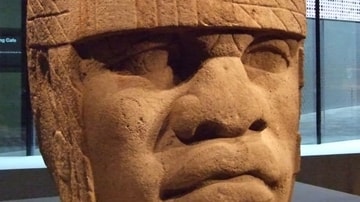
Olmec Colossal Head
A basalt colossal head from the Olmec civilization of Mesoamerica. Provenance: Veracruz, Mexico, 1200-900 BCE. The significance of the heads is disputed but as no two heads are alike and each headdress has distinctive designs...

Image
Mesoamerican Canine Vessel
Ceramic Mesoamerican canine vessel from South-Central Veracruz, Mexico, c. 600 to c. 900. This open ceramic bowl from the Veracruz Late Classic period features a mould-made effigy of a canine resembling a xoloitzcuintle...
