
Search
Remove Ads
Advertisement
Search Results

Image
Saint Juan Diego Cuauhtlatoatzin
Saint Juan Diego Cuauhtlatoatzin, photograph by Nheyob, Jalisco, 03 March 2015. This photograph is of Saint Juan Diego Cuauhtlatoatzin from the Basilica of Our Lady of Zapopan in Jalisco, Mexico. The saint is depicted...

Image
Doña Marina, La Malinche
Doña Marina (La Malinche), book illustration included in The Mastering of Mexico by Kate Stephens, p. 65, 1916. La Malinche, Malintzin, or Doña Marina, was a key figure in the fall of the Aztec Empire and the absorption...

Image
Huexotl Willow Tree
Huexotl, ink and paint on parchment, unknown artist, included in the Florentine Codex by Bernardino de Sahagún, Book 11, folio 144v, Mexico, 1577. A willow tree, known as huexotl in Nahuatl, grows from a body of curling blue...

Image
Major Edward W. Wynkoop
Major Edward W. Wynkoop, one of the founders of Denver Colorado, c. 1864.
New Mexico State Library.

Image
La Malinche Leads the Spanish
La Malinche leading Hernán Cortés and the Spanish, illustration in Codex Azcatitlan by unknown author, p. 23, c. 1501-1600. This image is an indigenous pictorial representation of the Spanish marching on the Aztec...

Image
Sacred Precinct, Tenochtitlan
A model reconstruction of the sacred precinct of Tenochtitlan, the Aztec capital on Lake Texcoco. The city was founded in 1345 CE and fell to the Spanish forces led by Cortés in 1521 CE. The sacred complex was dominated...

Image
Zapotec Jade Bat Assemblage
A jade assemblage representing a leaf-nosed bat. Likely worn as a belt or chest adornment. From a Zapotec royal tomb at Monte Alban, Mexico.

Image
La Malinche Mediates with the Tlaxcallans
La Malinche mediates discussions between Tlaxcallans and Hernán Cortés, mural by Desiderio Hernández Xochitiotzin, photograph by Wolfgang Sauber, Tlaxcala, 28 March, 2008. The Tlaxcallans are an indigenous...
Image
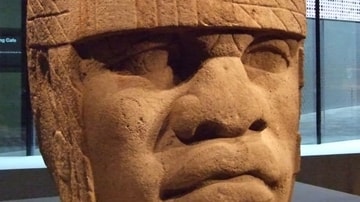
Olmec Colossal Head
A basalt colossal head from the Olmec civilization of Mesoamerica. Provenance: Veracruz, Mexico, 1200-900 BCE. The significance of the heads is disputed but as no two heads are alike and each headdress has distinctive designs...

Image
Mesoamerican Canine Vessel
Ceramic Mesoamerican canine vessel from South-Central Veracruz, Mexico, c. 600 to c. 900. This open ceramic bowl from the Veracruz Late Classic period features a mould-made effigy of a canine resembling a xoloitzcuintle...
