
Search
Remove Ads
Advertisement
Search Results

Definition
Cleopatra VII - The Last Great Pharaoh of Ancient Egypt
Cleopatra VII (69-30 BCE, reign 51-30 BCE) was the last ruler of Egypt before it was annexed as a province of Rome. Arguably the most famous Egyptian queen, Cleopatra was ethnically Greek as a member...

Definition
Sophocles
Sophocles of Kolōnos (c. 496 - c. 406 BCE) was one of the most famous and celebrated writers of tragedy plays in ancient Greece and his surviving works, written throughout the 5th century BCE, include such classics as Oedipus Rex...
Definition
The Children of Heracles
The Children of Heracles (Heraclidae) is one of Euripides' lesser-known and least popular works, as is the myth surrounding the tragedy play. Its date is also uncertain, possibly written in the late 430s or early 420s BCE...

Definition
Oedipus the King
Oedipus the King (429-420 BCE), also known as Oedipus Rex or Oedipus Tyrannos ('Tyrannos' signifies that the throne was not gained through an inheritance) is the most famous surviving play written by the 5th-century BCE poet and...

Definition
Lycia
Lycia is a mountainous region in south-west Anatolia (also known as Asia Minor, modern-day Turkey). The earliest references to Lycia can be traced through Hittite texts to sometime before 1200 BCE, where it is known as the Lukka Lands...

Definition
Hyperborea
In Greek mythology, Hyperborea was the land located to the far north of the known world and it was so remote it was considered even beyond the North Wind. There a legendary race known as the Hyperboreans lived and worshipped the sun...

Image
Greek Wrestlers
A relief from a funerary kouros base depicting two Greek wrestlers, one of the sports at such events as the Olympic Games at Olympia. c. 510 BCE. (National Archaeological Museum, Athens)
Image
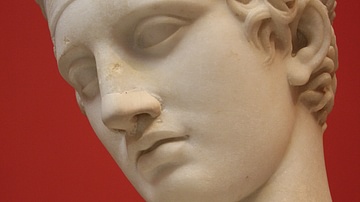
Greek Athlete
A Greek athlete wearing the ribbon of victory (diadoumenos). 1st century BCE copy of a 5th century BCE original by Polykleitos, Delos. (National Archaeological Museum, Athens)

Image
Greek Bronze Ballot Disks
Bronze ballot disks used in Greek courts to vote guilty (a hole in the centre) or innocent (a solid centre). c. 300 BCE. (Agora Museum, Athens)
Image
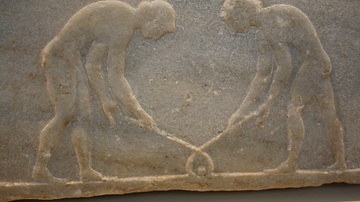
Greek Hockey Players
Greek athletes playing a game similar to modern hockey. From the base of a funerary kouros, later included in the Themistokleian Wall of Athens. 510-500 BCE. (National Archaeological Museum, Athens)
