
Search
Remove Ads
Advertisement
Search Results

Definition
Mesrop Mashtots
Mesrop Mashtots (360/370 - c. 440 CE) invented the Armenian alphabet in 405 CE. Besides greatly increasing levels of literacy in the country, the language permitted ordinary people to read the Bible for the first time, thus helping...

Definition
Cerveteri
Cerveteri (Etruscan name: Cisra or Caisra, Greek: Agylla, Roman: Caere) was an important Etruscan town which flourished between the 7th and 4th century BCE. Located near the western coast of central Italy, around 50 km north of Rome...

Definition
Helen of Troy
Helen of Troy (sometimes called Helen of Sparta) is a figure from Greek mythology whose elopement with (or abduction by) the Trojan prince Paris sparked off the Trojan War. Helen was the wife of Menelaus, the king of Sparta, and...

Definition
Apollo
Apollo was a Greek god associated with the bow, music, and divination. The epitome of youth and beauty, source of life and healing, patron of the arts, and as bright and powerful as the sun itself, Apollo was perhaps the most loved of...

Definition
Proclus
Proclus of Athens (c. 412-485 CE) was a prolific Platonic philosopher whose main aim was the seemingly impossible task of defending traditional Greek polytheism at the time when his contemporary culture was almost completely dominated...

Definition
Odysseus
Odysseus (Roman name: Ulysses) was one of the great pan-Hellenic heroes of Greek mythology. He was famous for his courage, intelligence, and leadership. Odysseus' resourcefulness and oratory skills were instrumental in the Greek victory...

Image
Greek Trireme Model
A model of a trireme from ancient Greece. (Archaeological Museum, Hania, Crete)
Image
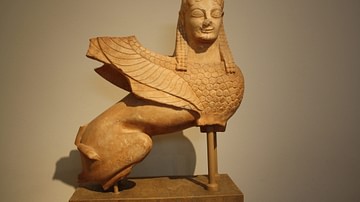
Greek Funerary Sphinx
A sphinx in pentelic marble, from a funerary stele, c. 570 BCE.
National Archaeological Museum, Athens.
Image
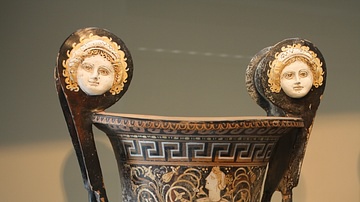
Greek Volute Krater
This vessel was used to mix wine and water and dates from the second half of the fourth century BCE. Provenance: Apula. Depicted are two female figures with gifts approaching a deceased person seated on a funeral monument...

Image
Greek Chariot
A depiction of a chariot with charioteer on an attic black-figure kylix (510-500 BCE). Olympia Archaeological Museum.
