
Search
Remove Ads
Advertisement
Search Results

Image
The Nine Muses of Greek Mythology
The Nine Muses of Greek mythology were divine daughters of Zeus and Mnemosyne (Memory), revered as patrons of poetry, song, history, and the arts. Early Greek tradition sometimes spoke of an earlier triad—Mneme (Memory...

Video
The Greek God Apollo: The Myths of the Olympian God of Music, Medicine, the Sun and Archery
The god Apollo in Greek mythology is the Olympian god of, well, quite a lot! Apollo is associated with the bow, music, divination, the sun, poetry, healing and medicine...
Image
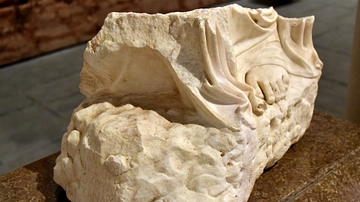
Greek Artist's Signature
The sculptor's signature, written in Greek, can be seen on the base (left) of this marble statue. The text reads "Antoninus Alexandreus, son of Antiochos, made this by himself". The statue may be of Apollo or a muse. The...

Image
Greek and Phoenician Colonization
Both the ancient Greeks and Phoenicians extensively colonized vast areas of Europe, along the Mediterranean and Black Sea coasts. In doing so, they spread their culture, which strongly influenced the local tribes...

Definition
Battle of Thermopylae
Thermopylae is a mountain pass near the sea in northern Greece which was the site of several battles in antiquity, the most famous being that between Persians and Greeks in August 480 BCE. Despite being greatly inferior in...

Definition
Ajax (Play)
Ajax is a play written by the 5th-century BCE Greek poet and dramatist Sophocles. Although Sophocles wrote at least 120 plays, only seven have survived. Of his surviving plays, the best-known is Oedipus Rex (Oedipus the King) - part...

Definition
White Huns (Hephthalites)
The White Huns were a race of largely nomadic peoples who were a part of the Hunnic tribes of Central Asia. They ruled over an expansive area stretching from the Central Asian lands all the way to the Western Indian Subcontinent...

Definition
Egyptian Hieroglyphs
The Egyptian hieroglyphic script was one of the writing systems used by ancient Egyptians to represent their language. Because of their pictorial elegance, Herodotus and other important Greeks believed that Egyptian hieroglyphs...

Image
Greek Erotic Scene
Attic ceramic kylix or drinking cup (490-480 BCE) depicting an erotic scene. The male holds a sandal, often used as an instrument for stimulation in erotic games. (Archaeological Museum, Milan)

Image
Greek Wrestling
A detail of a wrestling scene, c. 510 BCE from the base of a funerary kouros. (National Archaeological Museum, Athens)
