
Search
Remove Ads
Advertisement
Search Results

Article
Continuity and Change after the Fall of the Roman Empire
The cataclysmic end of the Roman Empire in the West has tended to mask the underlying features of continuity. The map of Europe in the year 500 would have been unrecognizable to anyone living a hundred years earlier. Gone was the solid boundary...
Article
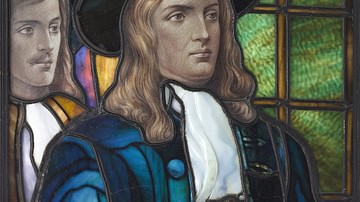
William Penn's Holy Experiment
In the 17th century, many groups of British Christians rose and fought against religious intolerance and corruption. The Puritans sought a return to biblical religion and a purified form of Christianity in England. This resulted in the Puritan...

Definition
Revolt of the Parlements
The Revolt of the Parlements of 1787-1788, was the climax of a power struggle between the royal authority of King Louis XVI of France (r. 1774-1792) and the Parlement of Paris, the most powerful of France's thirteen parlements, or high judicial...

Definition
Voltaire
Voltaire (1694-1778) was a French author, historian, and philosopher whose thoughts on religious toleration and moderation of authoritarian power were influential during the Enlightenment. His most famous work today is the satirical Candide...

Definition
John Locke
John Locke (1632-1704) was an English philosopher responsible for laying the foundation of the European Enlightenment. Locke believed that each branch of government should have separate powers, that liberty must be protected from state interference...
Article
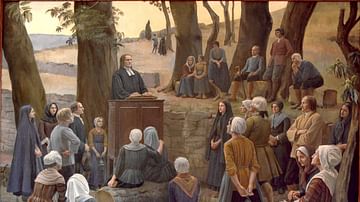
Antoine Court & the Church of the Desert
In March 1715, Louis XIV of France (r. 1643-1715) issued a declaration stating that all subjects of the king were also subjects of the Catholic Church. In defiance of the king's decree, Antoine Court (l. 1696-1760) gathered a small group...
Article
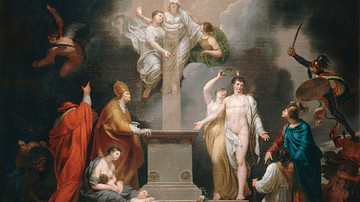
Napoleonic Concordat of 1801 & Religious Pluralism
The Napoleonic Concordat of 1801 defined France's relationship with the Catholic Church for over 100 years. The Organic Articles were added in 1802 and provided state recognition of the Reformed and Lutheran confessions alongside the Catholic...
Article
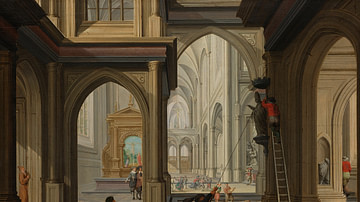
Reformation in the Netherlands & the Eighty Years' War
The Protestant Reformation in the Netherlands was among the most violent and destructive of any region during the first 50 years of the movement, ultimately informing the Eighty Years' War (1568-1648), but causing massive destruction and...

Definition
The Hittites
The Hittites occupied the ancient region of Anatolia (also known as Asia Minor, modern-day Turkey) prior to 1700 BCE, developed a culture apparently from the indigenous Hatti (and possibly the Hurrian) people, and expanded their territories...

Definition
William the Silent
William the Silent (l. 1533-1584, also known as William of Orange) was the leader of the Dutch Revolt (the Eighty Years' War) in the Netherlands; first politically (between 1559-1568) then militarily (between 1568-1584). He is among the most...
