
Search
Remove Ads
Advertisement
Search Results

Definition
Anastasios I
Anastasios I ruled the Byzantine empire from 491 to 518 CE. Although his tax and monetary reforms were both popular and successful, the emperor could not repair the damaging split in the Christian Church created by his predecessors. He faced...

Definition
Azuchi-Momoyama Period
The Azuchi-Momoyama Period (Azuchi-Momoyama Jidai, aka Shokuho Period, 1568/73 - 1600 CE) was a brief but significant period of medieval Japan's history which saw the country unified after centuries of a weak central government and petty...

Definition
Jeanne d'Albret
Jeanne d’Albret (Joan III of Navarre, l. 1528-1572) was Queen of Navarre, daughter of Marguerite de Navarre (l. 1492-1549) and niece of King Francois I (Francis I of France, r. 1515-1547). She is best known for leading the Huguenots (French...
Definition
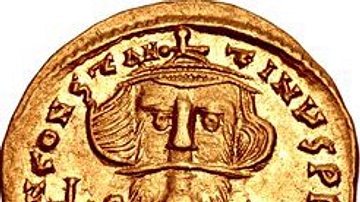
Constans II
Constans II (aka Konstans II) was emperor of the Byzantine Empire from 641 to 668 CE. Sometimes known as Constans Pogonatos (“the Bearded”), he came to the throne by a series of unlikely events and his empire was immediately challenged almost...
Definition
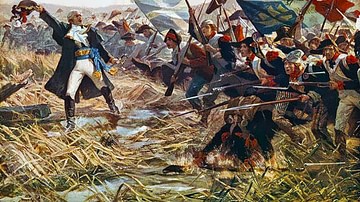
Battle of Jemappes
The Battle of Jemappes was a decisive battle in the War of the First Coalition (1792-97), part of the French Revolutionary Wars (1792-1802). On 6 November 1792, a French army under General Charles-François Dumouriez defeated an Austrian force...
Article
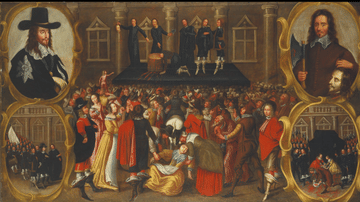
Consequences of the English Civil Wars
The impact and consequences of the English Civil Wars (1642-1651) were many and far-reaching. Charles I of England (r. 1625-1649) was executed, and the monarchy was abolished. Oliver Cromwell (1599-1658) then headed the Republic as the Lord...

Article
Luther's Speech at the Diet of Worms
Martin Luther's speech at the Diet of Worms (also known as the Here I Stand Speech) is considered one of the greatest pieces of oratory in world history. It was given in response to the council's questions on whether Luther would stand by...

Article
The Three Estates of Pre-Revolutionary France
Society in the Kingdom of France in the period of the Ancien Regime was broken up into three separate estates, or social classes: the clergy, the nobility, and the commoners. These classes and their accompanying power dynamics, originating...

Article
The Separation of Christianity from Judaism
In the mid-2nd century CE, Christianity began a gradual process of identity-formation that would lead to the creation of a separate, independent religion from Judaism. Initially, Christians were one of many groups of Jews found throughout...

Article
Rome's Response to the Spread of Christianity
During the 1st century CE, a sect of Jews in Jerusalem claimed that their teacher, Jesus of Nazareth, was the 'messiah' of Israel. 'Messiah' meant 'anointed one', or someone chosen by the God of Israel to lead when God would intervene in...
