
Search
Remove Ads
Advertisement
Search Results

Article
Christian Antisemitism in the Middle Ages & during the Reformation
Antisemitism is a modern term that describes prejudice and hostility to Jews and Judaism. The origins of Christian antisemitism in the gospels are based on the story of a 1st-century itinerant Jewish preacher, Jesus of Nazareth, in the Roman...
Article
Melito of Sardis and his Apology for Christianity
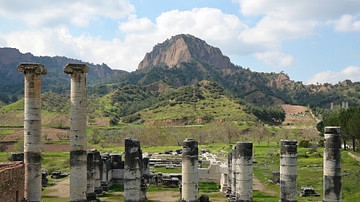
Melito of Sardis (d. c. 180 CE) was a bishop in the city of Sardis (near modern-day Sart, Turkey) who was regarded as one of the greatest Christian thinkers, writers, and apologists of his time. In the modern age, he is best known for his...
Article
Consequences of the English Civil Wars
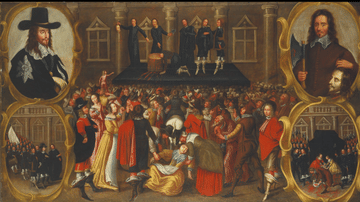
The impact and consequences of the English Civil Wars (1642-1651) were many and far-reaching. Charles I of England (r. 1625-1649) was executed, and the monarchy was abolished. Oliver Cromwell (1599-1658) then headed the Republic as the Lord...

Definition
Catherine the Great
Catherine II of Russia (Catherine the Great) was empress regent of Russia from 1762-1796. She was born in Prussia to Prince Christian August of Anhalt-Zerbst (1690-1747) and Princess Johanna Elisabeth of Holstein-Gottorp (1712-1760), and...

Definition
Constantine I
Constantine I, aka Constantine the Great, was Roman emperor from 306 to 337 CE. Realizing that the Roman Empire was too large for one man to adequately rule, Emperor Diocletian (284-305 CE) split the empire into two, creating a tetrachy or...
Definition
Picts
The Picts were a people of northern Scotland who are defined as a "confederation of tribal units whose political motivations derived from a need to ally against common enemies" (McHardy, 176). They were not a single tribe, nor necessarily...

Article
Reforms of Catherine the Great
Catherine II of Russia (Catherine the Great) was the empress regent of Russia from 1762 to 1796. During the mid-18th century, Russia was still regarded as culturally behind compared to Western European countries. However, during her reign...

Article
Christianity in Japan
Christianity arrived in Japan in 1549 when Jesuits first set foot in Kagoshima. Initial attempts to spread the religion were met with confusion; however, through employing various methods, they began to see success. However, by 1650, Christianity...

Definition
Ashoka the Great
Ashoka the Great (r. 268-232 BCE) was the third king of the Mauryan Empire (322-185 BCE) best known for his renunciation of war, development of the concept of dhamma (pious social conduct), and promotion of Buddhism as well as his effective...

Definition
Protestant Reformation
The Protestant Reformation (1517-1648) refers to the widespread religious, cultural, and social upheaval of 16th-century Europe that broke the hold of the medieval Church, allowing for the development of personal interpretations of the Christian...
