
Search
Remove Ads
Advertisement
Search Results

Definition
William the Silent
William the Silent (l. 1533-1584, also known as William of Orange) was the leader of the Dutch Revolt (the Eighty Years' War) in the Netherlands; first politically (between 1559-1568) then militarily (between 1568-1584). He...

Definition
Battle of Neerwinden
The Battle of Neerwinden saw the major defeat of a French republican army by an allied force of Austrians and Dutch during the War of the First Coalition (1792-97), part of the broader French Revolutionary Wars (1792-1802...

Definition
Glorious Revolution
The Glorious Revolution of November 1688 saw Protestant William of Orange (l. 1650-1702) invade England and take the throne of Catholic James II of England (r. 1685-1688). There were no battles, and William was invited by Parliament...
Article
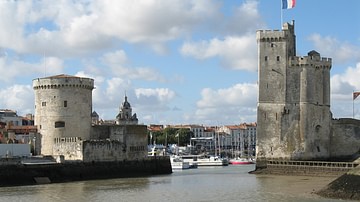
La Rochelle, a Protestant Stronghold of the French Reformation
La Rochelle emerged early in the French Reformation as a Protestant political and military center. The city's fortifications withstood repeated sieges over the years. In 1627, La Rochelle was...

Definition
Joseph II, Holy Roman Emperor - The Great Enlightened Despot
Joseph II, Holy Roman Emperor (1741-1790), was the son and successor of Maria Theresa (1717-1780) and Francis Stephen, aka Francis I (1708-1765), of the imperial house of the Habsburgs. He governed...

Definition
Horemheb
Horemheb (reigned 1320-1292 BCE) was the last pharaoh of the 18th dynasty of Egypt. He is also known as Dejserkheprure and Horemhab. His name means, “Horus is in Festival” and he came from the lower classes of Egypt, worked himself...

Definition
Louis I de Bourbon, Prince of Condé
Louis I de Bourbon (l. 1530-1569) was a descendant of Louis IX of France (r. 1226-1270) and founder of the House of Condé. The Prince of Condé proved his valor as a Huguenot military leader during the first three...

Article
War of the Eight Princes
The War of the Eight Princes (291-306 CE) is the conflict which weakened and finally ended the Western Jin Dynasty (266-316 CE) in China and resulted in more far-reaching consequences throughout the country. The power of...

Article
The Monastic Movement: Origins & Purposes
In 313 CE, Constantine the Great (272 – 337 CE) ended the sporadic-yet-terrifying Christian persecutions under the Roman Empire with his “Edict of Milan,” and brought the Christian church under imperial protection...

Definition
Thomas Paine
Thomas Paine (1737-1809) was an Anglo-American Enlightenment thinker whose radical ideas were taken up by revolutionaries in both the American Revolution (1765-1783) and the French Revolution (1789-1799). A Founding Father through...
