History is a public good. Help us keep it that way.
World History Encyclopedia makes reliable history content freely available to all. Your year-end gift helps keep historical knowledge free from paywalls and accessible to learners everywhere.
During the Bronze Age, which spanned roughly from 3300 BCE to 1200 BCE, several powerful empires emerged, shaping the course of early civilization. In this collection of ten maps, we take a look at the empires that flourished in regions such as ancient Anatolia, Mesopotamia, and Egypt, empires which have left behind remarkable legacies of influence on many later cultures.
These Bronze Age empires, while distinct in their cultures and achievements, shared common features such as centralized authority, complex economies, and monumental architecture. Though they eventually declined or were overtaken by new powers, their legacies endured, laying the foundation for the civilizations that followed.
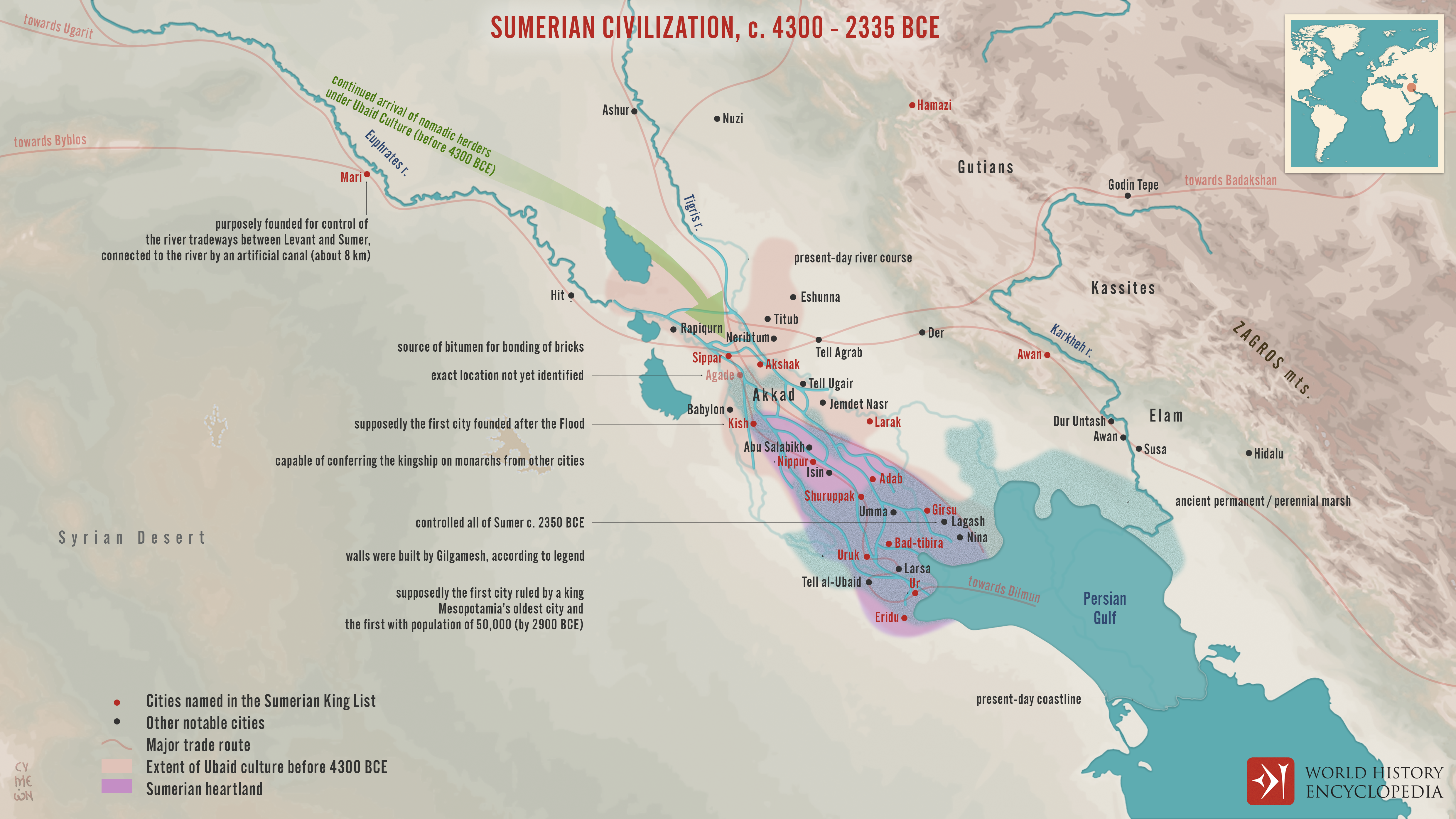
The rise of Sumeriancivilization in southern Mesopotamia (c. 6000–2300 BCE) represents one of the earliest transformations from agrarian village life to urban state formation. Located between the Tigris and Euphrates Rivers, this alluvial plain required large-scale irrigation management, fostering collective organization and administrative innovation. By the fourth millennium BCE (Uruk Period, c. 4000–3100 BCE), urban centers emerged that integrated agricultural surplus, long-distance trade, temple authority, and early bureaucratic systems. The region later known as Mesopotamia, home in subsequent centuries to Akkad and Babylonia, thus became a laboratory for early statecraft, shaped by environmental adaptation and socio-political competition.
Independent city-states such as Ur, Uruk, Lagash, and Eridu developed distinct political structures under rulers often titled ensi or lugal (Early Dynastic Period, c. 2900–2334 BCE). Monumental temple complexes (ziggurats), the development of cuneiformwriting (c. 3200 BCE), and advances in mathematics and law reflected increasingly sophisticated administrative needs. Although rivalry and warfare were frequent, shared religious traditions and linguistic culture fostered a broader Sumerian identity. Even after the rise of the Akkadian Empire under Sargon of Akkad (reign c. 2334–2279 BCE), Sumerian cultural models endured, shaping Mesopotamian political and intellectual life for centuries.
Uploaded by Simeon Netchev, published on 27 February 2026. The copyright holder has published this content under the following license: Creative Commons Attribution-NonCommercial-NoDerivs. This licence only allows others to download this content and share it with others as long as the author is credited, but they can't change the content in any way or use it commercially. When republishing on the web a hyperlink back to the original content source URL must be included. Please note that content linked from this page may have different licensing terms.