
Search
Remove Ads
Advertisement

 This answer was generated by
 Search Results
Image
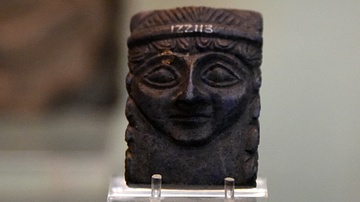
Lapis Lazuli Plaque in the Shape of a Woman's Face
This lapis lazuli inlay was carved in the shape of a woman's head and is quadrangular. The back is flat except for two straight incised lines continuing the line of the headband on the face. Height...
Image
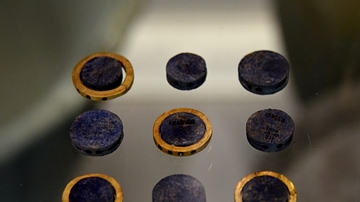
Lapis Lazuli Discs with Gold Rings from Ur
The lapis lazuli discs were carved and polished. They have two perforations through their diameter. They display a flat surface and a grooved circumflex. Each disc is surrounded by a single hammered gold ring...
Image
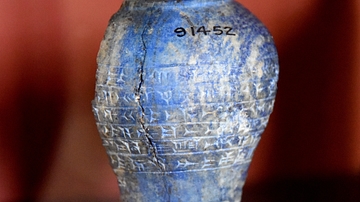
Portion of a Lapis Lazuli Head-Mace from the Temple of Ninurta
This fragment of a lapis lazuli Head-mace was inscribed with six lines of cuneiform inscriptions. The name of Ashurnasirpal II (reigned 884-859 BCE) was mentioned in this dedicatory text. Neo-Assyrian...
Image
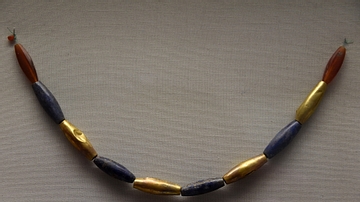
Puabi's Belt of Gold, Lapis Lazuli, and Carnelian Beads
This is a group of barrel-shaped beads of bitumen overlaid with four gold, four lapis lazuli, and two faceted cornelian beads. This jewellery was found by Puabi's thighs inside her grave, which...

Image
Puabi's Lapis Lazuli & Agate Beads with a Calf Pendant, Ur
The jewellery was found by Puabi's right shoulder inside her grave. Puabi was a Semitic Akkadian woman from Ur, c. 2600 BCE, possibly a queen or priestess. Possibly this was part of her headdress...

Article
Enki's Journey to Nippur - A Celebration of Life
Enki's Journey to Nippur (circa 2000 BCE) is a Sumerian origin myth explaining the creation of the temple at Eridu by the god Enki and how musical instruments were ordained for use in festivals in ancient...

Article
Hymn to Nisaba - A Praise Song for the Sumerian Goddess of Writing
The Hymn to Nisaba (circa 3rd millennium BCE) is a poem praising Nisaba, the Sumerian goddess of writing and accounts who also served as scribe of the gods. The poem is officially dedicated...
Image
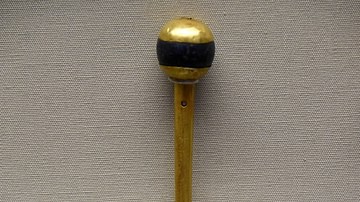
Gold and Lapiz Lazuli Pin of Puabi, Ur
This gold toggle was found with the body of Puabi herself inside her grave, by her upper left arm. Puabi was a Semitic Akkadian woman from Ur, c. 2600 BCE, possibly a queen or priestess. The lapis lazuli head...

Image
Puabi's Gold and Lapis Lazui Fish Amulets, Ur
This group was found (together with the gold antelopes amulet) on Puabi's arm inside her grave. Puabi was a Semitic Akkadian woman from Ur, c. 2600 BCE, possibly a queen or priestess. Early Dynastic Period...
Article
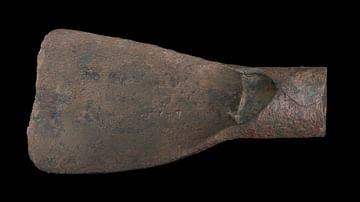
The Song of the Hoe - Praise for an Ancient Mesopotamian Farming Tool
The Song of the Hoe is a Sumerian praise poem celebrating the hoe for its many uses and linking it to the creation of the world by the great god Enlil. As the economy of Mesopotamia was...
