

Gaius Cassius Longinus (circa 86-42 BCE) was a leader of the 'Liberators', the faction of Roman senators who assassinated Julius Caesar on the Ides of March (15 March) 44 BCE. Motivated by a desire to save the Roman Republic from collapsing under one-man rule, or by a host of other more selfish reasons, Cassius plotted to kill Caesar along with approximately 60 other senators, including his brother-in-law, Marcus Junius Brutus. After the deed was done, Cassius and Brutus fled Rome and gathered an army, but were ultimately defeated by Caesar's successors at the Battle of Philippi. Preferring death to capture, Cassius committed suicide.
Family & Early Life
Cassius was born around 86 BCE – perhaps on 3 October – to the gens Cassia, a distinguished patrician family. His father was a senator who served as governor of Cisalpine Gaul around the time of the Third Servile War against the rebel gladiator Spartacus. Indeed, the elder Cassius was soundly defeated by Spartacus and his slave army near Mutina (Modena) in 72 BCE and, if the historian Plutarch is to be believed, was lucky to escape the battlefield with his life. While scholars do not know the name of Cassius's mother, she must have been a respected and influential woman since a politician once referenced her advice in a public speech.
As a young man, Cassius studied philosophy in Rhodes and became fluent in Greek. He eventually befriended one of the great philosophers of his own day, Marcus Tullius Cicero, who was evidently impressed by the young man. According to Cicero, Cassius was "the bravest of men, one who, ever since [he] first set foot in the Forum, [did] nothing unless it was filled to the brim with the most abundant dignitas" (quoted in Strauss, 71). Yet Cicero also recognized that Cassius possessed a mighty temper – the older statesman would recall that when Cassius got angry, his eyes blazed with an intensity that reminded him of the war god Mars. However, the most famous description of Cassius came not from Cicero but from William Shakespeare. In his Tragedy of Julius Caesar, written over 1,500 years later, the bard has Caesar say: "Yon Cassius has a lean and hungry look. / He thinks too much. Such men are dangerous." (1.2 195-96)
Lean and hungry though he may have been, Cassius also seems to have carried a love for the Roman Republic. According to Plutarch, when Cassius was a teenager, he went to school with Faustus, son of the late dictator Lucius Cornelius Sulla. Faustus had apparently been bragging about his father's autocratic powers when Cassius, unable to contain his fury, leaped on the other boy and gave him a beating. After Cassius was pried off, Faustus's guardians threatened to take him to court. However, Pompey Magnus, one of Sulla's former lieutenants, forbade this and promised to settle the matter himself. When Pompey brought the two boys together to settle their differences, Cassius sneered and said, "Come now, Faustus, have the courage to utter in this man's presence that speech which angered me, and I will smash your face again" (Plutarch, Life of Brutus, 9.1). The story, Plutarch asserts, proves that from an early age, Cassius harbored a "great hostility and bitterness toward the whole race of tyrants" (ibid).
Military Career
By the 50s BCE, the Roman Republic was ailing. For all intents and purposes, power was concentrated in the hands of only three men – Pompey the Great, Julius Caesar, and Marcus Licinius Crassus, who had joined together in an uneasy alliance that historians call the First Triumvirate. By then, Pompey was recognized as the greatest general of his generation, and Caesar was off campaigning in Gaul, covering himself in glory and riches. Not one to be outdone by his fellow triumvirs, Crassus began planning his own military expedition against the Parthian Empire. A new eastern war offered opportunities for ambitious young officers like Cassius, who joined Crassus's army as a questor and deputy commander.

Initially, the expedition went well, and Crassus won minor victories against the Parthians in Syria. But then, the overconfident triumvir crossed the Euphrates and marched his army into unfamiliar enemy territory marked by scorching desert terrain. Before long, Crassus's luck ran out, and his legions were crushed at the Battle of Carrhae, 53 BCE, the worst Roman defeat since the days of Hannibal. Thousands of Roman soldiers were killed, several eagle standards were lost, and, shortly after the battle, Crassus himself was taken prisoner and executed, reportedly by having molten gold poured down his throat. As one of the only senior officers left standing, Cassius took command of the tattered remnants of the army. He led the 10,000 survivors back into Syria and holed up in Antioch, the center of Roman power in the region. There, he began to prepare for the Parthian counterattack.
The attack came later that year when a Parthian army, led by General Osaces, invaded Syria and laid waste to everything in its path. By then, Cassius was ready – when the Parthians reached Antioch, they failed to breach the walls. Unable to maintain a siege, they turned away and went back to raiding the Syrian countryside. For the next two years, Cassius waged a quasi-guerrilla war against the invaders, using Antioch as his base from which he sent out troops to harass the enemy flanks or pick off isolated groups of Parthian soldiers. Then, in 51 BCE, Cassius laid an ambush for the Parthians, which they walked right into. The Parthian army was devastated, and Osaces was mortally wounded. Upon the death of their commander, the surviving Parthians abandoned Syria. Though the victory was hardly grand enough to avenge Carrhae, it certainly cemented Cassius as a general to be reckoned with.
During his three years in Antioch, Cassius served as acting governor of Syria. He used this office to enrich himself by extorting the local population and by purchasing Syrian goods and reselling them at marked-up prices. His meddling with Syrian merchandise earned him the nickname 'the Date' after the fruit that grew on local palm trees, but, as historian Barry Strauss points out, this was not meant as a compliment. During his tenure, he also invaded Judea, capturing and enslaving as many as 30,000 Jews, who were later sold at a high price. Cassius was hardly the only Roman governor to engage in this kind of corruption. However, his later image as a paragon of republican virtue makes his actions as governor especially noteworthy.
Civil War
Cassius returned to Rome in 50 BCE on the eve of civil war. Pompey had served as sole consul in 52 BCE, a nearly unprecedented concentration of power in the hands of one man, while Caesar was still off prosecuting his dubiously legal war in Gaul. By now, the Optimates – a conservative faction in the Roman Senate – were demanding that Caesar give up his legions and return to Rome, to answer for crimes he was alleged to have committed, both before and during his war in Gaul. Should he refuse, the Senate would turn to Pompey, asking him to lead the republic's armies and bring Caesar to justice. In the end, Caesar agreed to return, but not to answer for any crimes, and certainly not alone. In January 49 BCE, he crossed the Rubicon at the head of his veteran legionaries.

Cassius, who had just been elected tribune of the plebs, sided with Pompey and the Senate. He fled Rome and went to Greece, where Pompey was marshaling an army. Put in charge of a Pompeian fleet, Cassius once again proved his military worth by destroying a Caesarian fleet off the coast of Sicily in 48 BCE. He spent the next few months harassing ships off southern Italy. But Cassius's naval successes were merely a sideshow to the war playing out in Greece. There, at the Battle of Pharsalus, Caesar won a decisive victory over Pompey, breaking his army. Defeated but undeterred, Pompey fled to Egypt but was unceremoniously assassinated as soon as he stepped ashore. Though the civil war would grind on for a few more years, the writing was already on the wall: Caesar had won.
Relationship with Caesar
After Pharsalus, many prominent Pompeians flocked to Caesar, seeking clemency. Eager to prove that he was merciful – and no doubt satisfied to see the proudest men in Rome groveling at his feet – Caesar pardoned most of those who asked for it, acting as though the civil war had been little more than a family quarrel. Among the prodigal senators seeking Caesar's pardon were big names like Cicero and Marcus Junius Brutus, Cassius's brother-in-law. Cassius himself initially planned to keep fighting but was eventually persuaded, perhaps by Brutus's example, to surrender. He met with Caesar in southern Anatolia and was pardoned. Cassius later claimed that he almost assassinated Caesar right then, though historians like Strauss dismiss this as a "tall tale" (74). Caesar welcomed Cassius back into the fold and made him a legate in his army.
Cassius participated in Caesar's campaign against King Pharnaces II of Pontus but refused to take up arms against the Pompeian holdouts in Africa led by his former allies Metellus Scipio and Cato the Younger. So, as Caesar mopped up the last remnants of Pompeian resistance, Cassius returned to Rome, where he hoped to resume his political career. But the rules of the game had changed – Caesar was now dictator, and all other public officials of the Roman government served at his pleasure. Cassius would learn this the hard way when Caesar appointed Brutus to the governorship of Cisalpine Gaul, even though Cassius's experience in Syria made him the more qualified candidate. In late 45 BCE, Cassius lost another job to his brother-in-law when Caesar gave Brutus the prestigious office of urban praetor. Enraged, Cassius refused to speak to Brutus for months.

This was not to say that Cassius's career had reached a dead end. In fact, Caesar, who was making political appointments years in advance, agreed to let Cassius be consul in 41 BCE. But it was precisely this idea of having to kowtow to Caesar to get ahead that rankled Cassius, offending his sense of dignitas – a complex virtue encompassing both personal honor and prestige. Of course, Cassius may have also nursed a personal grudge against the dictator. Rumor had it that Caesar, a notorious womanizer, was sleeping with Cassius's wife, Junia Tertia (also Brutus's half-sister). There was also the story told by Plutarch that Caesar confiscated some lions that Cassius had purchased in Megara for the games in Rome, and that this hurt his pride (Plutarch admits that the lions could have belonged to Cassius's brother, Lucius, instead).
Ambitions and personal grievances aside, Cassius was worried that Caesar was inching dangerously close to monarchism. In early 44 BCE, Caesar was made dictator for life (dictator perpetuo). Then, in the weeks that followed, he constantly trampled on tradition; first, he disrespected the Roman Senate by refusing to rise to greet a senatorial delegation, then he dismissed two tribunes for allegedly stirring up opposition. The final straw came during the Lupercalia festival on 15 February when Mark Antony, one of Caesar's lieutenants, repeatedly offered him a crown. Though Caesar refused, many saw this as a staged performance meant to test the waters of public opinion about making Caesar king. Cassius may very well have agreed with the words Shakespeare puts in his mouth regarding Caesar: "He doth bestride the narrow world / like a Colossus, and we petty men / walk under his huge legs and peep about / to find ourselves dishonorable graves" (Julius Caesar 2.1, 142-145).
Conspiracy
It was probably not until February 44 BCE that Cassius decided the only way to save the republic was to murder Caesar. It was not difficult for him to recruit other disgruntled senators into the conspiracy, as many powerful men had a bone to pick with the dictator. Some were former Pompeians who were angry that Caesar had not given back all the property he had confiscated from them. Others were stout Optimate conservatives outraged at Caesar's reforms, which included giving land to his veterans and grain doles to the urban poor, as well as adding foreigners to the Senate. Others simply wanted to preserve the republic. All told, it is likely that 60 senators joined the conspiracy (although probably fewer than 20 took an active part in the murder itself).
But there was one man that Cassius needed above any other: Brutus. According to myth, it had been Brutus's ancestor who had chased the last kings out of Rome, and his name would add much symbolic weight to the conspiracy. Putting aside his recent quarrel with the man, Cassius visited the home of his brother-in-law on a cold February evening. He convinced him that, unless they did something to stop the ambitious Caesar, the republic would fall. Brutus ultimately agreed. Where Cassius was the brains of the conspiracy, Brutus became the heart. When Cassius proposed killing Mark Antony as well as Caesar, Brutus talked him out of it, arguing that they were acting to save the republic, not making a power grab. Plans were hashed out, and it was agreed that they would act at the Senate meeting on the Ides of March (15 March), days before Caesar was scheduled to leave the city on a military campaign against the Parthians.
The Ides
Caesar arrived late to the Senate meeting on the day he was to die. Initially, he had made up his mind not to go at all – he had woken up dizzy and had been beset all that morning with bad omens. But Cassius knew that they might not get another chance to do the deed. So, when Caesar did not show up on time, he sent Decimus Brutus Albinus, a man the dictator trusted, to fetch him. Decimus succeeded in luring Caesar to the Portico of Pompey, where the Senate was meeting that day. Upon entering the Senate House, he was swarmed by the assassins and stabbed a total of 23 times. He died at the feet of a statue of his great rival Pompey, murdered by the daggers of men he had thought his friends.

The conspirators – or ‘Liberators', as Cicero called them – then marched from the Portico of Pompey to the Capitoline Hill, their hands and togas still covered in blood. They spent the next two days holed up there, giving speeches justifying the murder. The Liberators did not leave the Capitoline until 17 March when a compromise was reached, brokered by Cicero: the assassins would be granted amnesty, and in return, Caesar's acts and appointments would still stand. That night, as a show of goodwill, Cassius went to have dinner at Antony's house. It was a tense meal. Antony asked if Cassius was hiding a dagger under his armpit, to which Cassius replied that he certainly did have a dagger for Antony, in case he, too, turned out to be a tyrant.
Philippi & Death
This brittle peace was short-lived. On 20 March, the day of Caesar's public funeral, a riot broke out – perhaps spurred on by Antony – with angry mobs threatening the homes of the conspirators. Things got so bad that Brutus and Cassius fled the city in mid-April, likely fearing for their lives. They went first to Antium (Anzio) in Italy, where they stayed for a few months. By August, however, it was clear that another round of civil wars was just over the horizon, leading Brutus and Cassius to go east in the hopes of raising an army. While Brutus went to Greece, Cassius went to his old stomping grounds of Syria. Over the course of the next year, he put together a formidable twelve-legion army.
In 43 BCE, Octavian – the 19-year-old adopted son of Caesar – came to power in Rome. He passed a law rescinding amnesty for the Liberators and declaring them enemies of Rome, before making common cause with Antony and another prominent Caesarian, Marcus Lepidus, who together formed the Second Triumvirate. Brutus and Cassius knew that it was only a matter of time before this new triumvirate came after them.

In the spring of 42 BCE, Cassius led his army to Rhodes, the Greek island where he had studied philosophy as a boy. But this time, he arrived with less peaceful intentions – since Rhodes had recently supported one of his enemies, he plundered it and put 50 of its leading men to death. Having thus filled his treasury with Rhodian gold and silver, he met up with Brutus and combined forces.
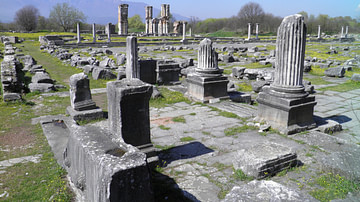
The ultimate showdown came on 3 October 42 BCE at a place in eastern Macedonia called Philippi. It was Cassius's birthday, and the odds seemed favorable – he and Brutus commanded upwards of 80,000 infantry and 20,000 cavalry, and they controlled the high ground, while their opponents, Octavian and Antony, were in a less favorable position and running out of food. But the Liberators underestimated the resourcefulness of Antony, who had snuck around their flanks to threaten their supply lines. Antony attacked, pushing Cassius's men back to their camp.
Cassius saw his men running and falsely believed that Octavian had routed Brutus's army as well. Preferring death to capture, he ordered one of his freedmen called Pindarus to decapitate him. When Brutus learned of Cassius's death, he mourned him as "the last of the Romans" (Plutarch, Life of Brutus, 44.2). He had him buried in secret so as not to lower the morale of the soldiers. Three weeks later, Brutus was also defeated and committed suicide. With Brutus and Cassius died the dream of the Roman Republic. Within three years of the assassination of Julius Caesar, as the historian Suetonius notes, the men most responsible were dead.