
Search
Did you mean: Tomb?
Remove Ads
Advertisement
Search Results

Definition
Edo Period
The Edo period refers to the years from 1603 until 1868 when the Tokugawa family ruled Japan. The era is named after the city of Edo, modern-day Tokyo, where the Tokugawa shogunate had its government. It is also sometimes referred to as the...

Definition
Shogun
The shoguns of medieval Japan were military dictators who ruled the country via a feudal system where a vassal's military service and loyalty was given in return for a lord's patronage. Established as an institution by the first shogun proper...

Definition
Meiji Restoration
The Meiji Restoration was a political event that took place in Japan in 1868. In it, the Tokugawa family, a warrior clan that had ruled Japan for more than 260 years, was overthrown by a group of political activists who proclaimed that their...

Definition
Yayoi Period
The Yayoi Period is one of the oldest historical periods of Japan spanning from c. 300 BCE to c. 250 CE, preceded by the Jomon Period and followed by the Kofun Period. The name Yayoi comes from the district in Tokyo where the first artifacts...

Definition
Emperor of Japan
The emperor of Japan is a position as the head of state which traditionally dates back to the 7th century BCE and the legendary figure of Emperor Jimmu (r. 660-585 BCE). Emperors came to be known as the Tenno or 'heavenly sovereign' in reference...

Definition
Mount Fuji - Japan's Tallest and Most Sacred Mountain
Mt. Fuji (Fujisan) is the tallest mountain in Japan and, with its classically symmetrical snow-capped cone, has long been the symbol of that country. The volcano is regarded as a sacred kami or spirit in the Shinto religion, specifically...

Definition
Tokugawa Iemitsu
Tokugawa Iemitsu (1604-1651) governed Japan as the third shogun of the Edo period. He implemented a number of important policies that not only consolidated his family's hold on power but also greatly impacted Japanese society for several...
Definition
Hachiman - Origin of the Kamikaze Wind
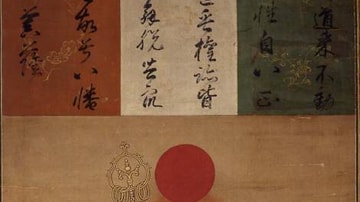
Hachiman is the ancient Shinto god or kami of war, divination, and culture. He is famously credited with sending the kamikaze or 'divine wind' which twice dispersed the invading fleets of Mongol ruler Kublai Khan in the 13th century CE. This...
Definition
Sumo - Japan's Ancient Form of Wrestling
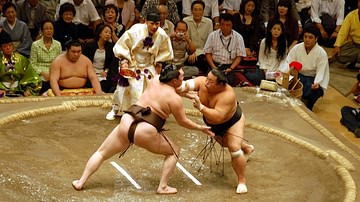
Sumo (Ozumo) is an ancient form of wrestling which has long been the national sport of Japan. Its origins go back to the Yayoi period (c. 300 BCE - c. 300 CE) and it incorporates many elements of the Shinto religion in its various rituals...
Definition
Kiyomizu-dera
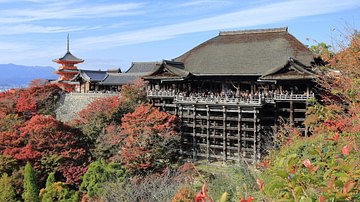
Kiyomizu-dera, otherwise known as the 'Temple of the Pure Water Spring', is a Buddhist temple in Kyoto, Japan. The site is famous for its impressive viewing platform, three-storey Koyasu pagoda and the medicinal pure waters of the Otowa Spring...
